One. Course Details
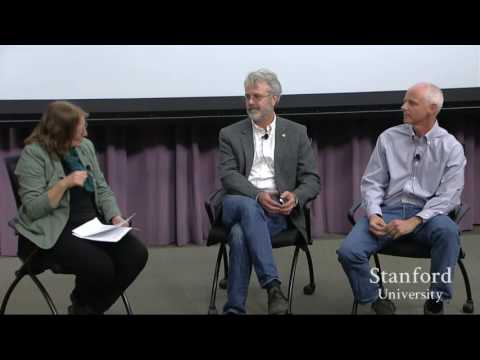
This is a guest lecture for EE292H Engineering and Climate Change at Stanford University, featuring Martin Eberhard and Marc Tarpenning, the original co-founders of Tesla Motors. The lecture was delivered in 2016, shortly after the launch of the Model 3 pre-order campaign and just before the release of the Chevy Bolt. The co-founders arrived in the second Tesla Roadster ever produced, kicking off a candid conversation about their unlikely journey building the world's most valuable car company. They share unvarnished lessons from hardware entrepreneurship, deep technical insights into battery and powertrain technology, and a clear-eyed analysis of the policies and market forces shaping the global transition to electric transportation. The lecture concludes with a wide-ranging Q&A covering funding challenges, infrastructure, and the future of mobility.
The lecture covers:
-
The origin story of Tesla Motors and the founders' motivation to build electric cars
-
The counterintuitive premium market entry strategy that made Tesla successful
-
Why lithium-ion batteries beat all other energy storage technologies
-
The technical and economic case against hydrogen fuel cell vehicles
-
The critical difference between pivoting in software vs. hardware startups
-
How Tesla revolutionized the auto industry's sales model
-
The real economics of electric vehicles vs. gasoline cars
-
The role of policy in accelerating or delaying the clean energy transition
Two. Key Learning Takeaways
-
New technologies cannot compete on price in mature industries. Tesla succeeded by first building a high-performance sports car for wealthy early adopters, then using those profits to develop progressively cheaper vehicles.
-
Lithium-ion batteries will remain the dominant energy storage technology for the foreseeable future, as lithium is the smallest solid ion on the periodic table and has no viable replacement for ion-exchange batteries.
-
Hydrogen fuel cell vehicles are 3–4 times less efficient than battery electric vehicles, and their continued development is driven almost entirely by distorted government subsidies, not technical merit.
-
Hardware startups have far less flexibility to pivot than software startups. You cannot change your core product mid-development, so you must validate all critical assumptions before committing to manufacturing.
-
The traditional automotive franchise system is fundamentally broken. Tesla's direct-to-consumer sales model was not a marketing choice—it was a necessity to avoid being trapped by state laws that give dealers permanent monopolies.
-
Tesla's greatest achievement was not building a successful car company—it was changing the entire world's perception of electric vehicles, forcing every major automaker to launch their own electric programs.
-
Electric vehicles will reach manufacturing cost parity with gasoline cars by 2022. After that point, they will be both cheaper to buy and cheaper to operate, making gasoline cars obsolete in the global market.
Three. Course Gold Quotes
-
"In 2002, everybody in the world knew two things about electric cars: one, they're dead, and two, they suck. They all looked like clown cars or golf carts."
-
"You cannot expect any new technology, especially competing in a very mature industry, to compete on price. When flat screen TVs came out, they weren't cheap. They were really expensive."
-
"Hydrogen is not a fuel. The efficiency of a fuel cell system is on the order of 20 to 22% efficient. Compare that to a lithium battery which runs on the order of 95% efficient. It's just not worth it."
-
"If you're building something physical, big physical thing like a car, you can't just say, 'Ah, toasters, we really need to make toasters.' Pivots work very differently in hardware."
-
"The biggest thing Tesla Motors did was not make one particular model car. Tesla completely changed the whole world's mind about what an electric car can do and what to expect out of them."
-
"Gasoline is super energy dense, but almost all of that energy is wasted as heat. That's why gasoline cars need huge radiators. Electric motors are over 90% efficient."
-
"The most meaningful thing any of us can do is work on solving a real problem rather than just trying to get rich. Find something that matters and build it."
Four. Layered Learning Notes
Module 1: The Founding of Tesla: From Energy Analysis to Roadster
-
The founders' journey began with a well-to-wheel energy analysis of every possible transportation technology, including hydrogen, natural gas, biodiesel, and electricity. They were stunned to discover that electric vehicles were not just better—they were dramatically better than all alternatives.
-
Eberhard and Tarpenning met socially through a mutual friend and bonded over technical conversations and games of Magic: The Gathering. They discovered they shared a similar approach to problem-solving and a frustration with the state of the auto industry.
-
Tesla was incorporated on July 1, 2003, purely to beat the Fourth of July holiday. The founders later realized they had missed Nikola Tesla's birthday (July 10) by just nine days.
-
A critical early insight: Electric cars live and die by their batteries. The founders recognized that the shift from nickel-metal hydride to lithium-ion batteries in consumer electronics created an opportunity to scale this technology for automotive use.
-
They deliberately avoided "science projects" and only used proven, mass-produced components. They partnered with Lotus to build the chassis and body, focusing their engineering efforts exclusively on the electric powertrain.
Module 2: The Premium Market Strategy: Why Starting at the Top Was the Only Way
-
Every previous electric car failed because manufacturers tried to build cheap, affordable cars first. This is impossible for a new technology competing in a 100-year-old industry with massive economies of scale.
-
The founders observed a clear market gap in Palo Alto: wealthy consumers who owned both high-performance sports cars (Porsche, BMW) and Toyota Priuses. These customers wanted a car that was both fun to drive and environmentally responsible.
-
The Tesla Roadster was designed to shatter all stereotypes about electric cars. It was faster than most gasoline sports cars of its era, proving that electric vehicles could be desirable, not just practical.
-
This strategy created a virtuous cycle: profits from the Roadster funded the development of the Model S, profits from the Model S funded the Model 3, and so on, progressively bringing electric cars to larger segments of the market.
Module 3: Hard Lessons from Hardware Entrepreneurship
-
Pivoting in hardware is exponentially harder than in software. Once you freeze the design of a physical product and start manufacturing, you cannot make fundamental changes without incurring massive costs and delays.
-
The biggest pivot Tesla made was abandoning the traditional dealership sales model. The founders discovered that state automotive franchise laws make it impossible to terminate a dealership contract, effectively giving dealers permanent control over the customer experience.
-
They modeled their direct sales strategy after Apple, building company-owned stores where customers could learn about electric cars without pressure from commissioned salespeople.
-
Unexpected markets are common in hardware. The founders' previous company, which made electronic books, found an unlikely customer base in the U.S. Navy, which used the devices on nuclear submarines because of their compact size and strong encryption.
Module 4: Battery Technology: The Engine of the Electric Revolution
-
Lithium is uniquely suited for batteries because it is the lightest and smallest metal on the periodic table. No other solid ion can move as easily through an electrolyte, giving lithium-ion batteries unmatched energy density.
-
Battery technology improves at a steady rate of approximately 7–10% per year, doubling in capacity and halving in cost every 7–10 years. This "battery Moore's Law" has been consistent for decades and shows no signs of slowing down.
-
Automotive demand has driven dramatic improvements in battery cycle life. Early lithium-ion batteries lasted only 2–3 years, but modern automotive batteries are designed to last 10–15 years.
-
Lithium is not a scarce resource. It is the 30th most common element on Earth, with vast reserves in Bolivia, Chile, and Australia. Unlike oil, lithium can be recycled indefinitely, and spent lithium-ion batteries already have positive cash value for recyclers.
-
Cobalt, often cited as a bottleneck, is only used in some battery chemistries. Manufacturers are already shifting to cobalt-free formulations using manganese and other abundant materials.
Module 5: The Hydrogen Myth: Policy Failure vs. Technical Reality
-
Hydrogen fuel cell vehicles are fundamentally less efficient than battery electric vehicles. The full cycle efficiency of a fuel cell system (electricity → hydrogen → compression → transport → fuel cell → electricity) is only 10–22%, compared to 90%+ for batteries.
-
This means a fuel cell car requires 3–4 times more energy to travel the same distance as an electric car, making it inherently more expensive to operate.
-
The only reason fuel cell development continues is government policy. The California Air Resources Board awards 10 times more zero-emission vehicle (ZEV) credits to fuel cell cars than to battery electric cars.
-
In the early 2000s, major automakers used fuel cell research as a public relations tactic to delay real electric vehicle development. Almost all fuel cell research was funded from corporate PR budgets, not engineering budgets.
Module 6: Energy Efficiency: The Hidden Advantage of Electric Cars
-
Gasoline cars are incredibly inefficient. Only about 20% of the energy in gasoline is converted into forward motion; the other 80% is wasted as heat. This is why gasoline cars have large, complex cooling systems.
-
Electric motors are over 90% efficient, meaning almost all of the energy stored in the battery is used to move the car. A Tesla Roadster with just 53 kWh of energy (equivalent to 1.5 gallons of gasoline) could travel 220 miles on a single charge.
-
Even when powered entirely by coal-fired electricity, electric vehicles are still approximately as efficient as a Toyota Prius. When powered by natural gas or renewable energy, their advantage becomes overwhelming.
-
The U.S. electric grid is remarkably efficient, with only 6–7% energy loss during transmission and distribution, according to studies by Argonne National Laboratory.
Module 7: Infrastructure and the Future of Mobility
-
Most electric vehicle charging happens at home, overnight. The vast majority of drivers never need public charging stations for their daily commute.
-
Public charging infrastructure should be focused on apartments, workplaces, and hotels, not on replicating the gas station model.
-
Vehicle-to-grid (V2G) technology is overhyped. 90% of the value of grid-integrated vehicles comes from simply controlling when they charge, not from selling energy back to the grid. This allows utilities to use electric cars as a massive, distributed battery to balance renewable energy generation.
-
Battery swapping is not a viable long-term solution. It requires maintaining a large inventory of spare batteries, increasing costs, and standardizing batteries would freeze technological progress.
-
Autonomous and shared vehicles will accelerate the transition to electric cars. Fleet operators have strong incentives to switch to electric vehicles due to their lower operating and maintenance costs.
Module 8: Funding, Policy, and the Road Ahead
-
Raising funding for Tesla was extraordinarily difficult. The founders pitched to over 100 venture capitalists, almost all of whom rejected the idea of a startup car company.
-
They refined their pitch by first presenting to VCs they knew would never invest, asking for honest feedback, and iterating on their business model.
-
Elon Musk joined Tesla nine months after its founding as the lead investor in the Series A round.
-
The federal government loan Tesla received was not a bailout—it was a competitive loan to build the Model S factory, which Tesla repaid in full, ahead of schedule.
-
The best energy policies mandate outcomes, not technologies. Governments should set strict emissions standards and let the market decide the cheapest way to meet them, rather than picking winners like hydrogen fuel cells.
-
By 2022, electric vehicles will be cheaper to manufacture than gasoline cars. At that point, the market will shift to electric vehicles naturally, regardless of subsidies or policy.
Wishing you all the courage to pursue your most ambitious ideas and the perseverance to see them through. The transition to clean transportation is one of the defining challenges and opportunities of our generation, and your engineering skills and creative problem-solving can help accelerate this critical shift. Whether you dream of starting your own company, joining an innovative team, or shaping the policies that will build our sustainable future, remember that every revolution begins with people who refuse to accept that "it can't be done." The world needs more builders who care about solving real problems—go out there and make your mark.