One. Course Details
This is the final lecture of EE292H Engineering and Climate Change at Stanford University, delivered by course instructor Leslie Field, a chemical engineer, MEMS expert, and founder of Ice 911 Research, a nonprofit focused on Arctic ice restoration. Field holds degrees from UC Berkeley and MIT, has worked at Chevron Research and HP/Agilent Labs, and runs a successful engineering consulting firm with 16 PhD-level team members.
The lecture wraps up the quarter’s curriculum with:
-
An update on the IPCC Fifth Assessment Report (2014 full release)
-
A frank discussion of geoengineering as an emergency climate backup
-
A deep dive into Field’s 7-year Ice 911 research project
-
Insights into climate entrepreneurship and the Cleantech Open accelerator
-
An open Q&A session addressing student concerns about risk, governance, and scalability
Two. Key Learning Takeaways
-
Global atmospheric CO₂ concentrations are now higher than at any point in the past 800,000 years, and emissions continue to exceed even the most pessimistic climate model projections.
-
Even if all emissions stopped today, climate change will persist for centuries due to the long atmospheric lifetime of CO₂ and ongoing thermal equilibration.
-
MIT’s updated "Greenhouse Gamble" model shows a less than 5% chance of limiting warming to below 3°C this century, with far higher probabilities of catastrophic 4-6°C increases.
-
Arctic sea ice melt is accelerating 20x faster than 2007 IPCC predictions, and the ice-albedo feedback loop now contributes 35% of global warming—a far larger impact than previously estimated.
-
Geoengineering is not a solution to climate change—it is a temporary band-aid to buy time for mitigation and adaptation, and carries severe, poorly understood risks.
-
Soft geoengineering approaches (local, reversible, nature-based) like Ice 911 carry far lower risk than large-scale solar radiation management techniques such as stratospheric sulfate injection.
-
Climate change is already costing trillions of dollars annually in infrastructure damage, and costs will rise exponentially without intervention.
Three. Course Gold Quotes
-
"It’s always about the team. You can’t possibly do most of what we try to do on your own."
-
"The scariest part of the IPCC report isn’t the projections—it’s that we keep exceeding their worst-case scenarios every single year."
-
"Geoengineering is the option you never want to use. But if your back is against the wall someday, you better have done your homework first."
-
"If you start stratospheric sulfate injection, you can never stop. If you do, temperatures spike faster than any species on Earth can adapt."
-
"Simple solutions are often the best. A plastic bottle filled with water and bleach can bring light to a windowless home—and a handful of reflective particles can save an Arctic glacier."
-
"I don’t give you scary stuff without a ray of hope. There are more people innovating to solve this problem than ever before."
-
"The ground rule for any climate intervention: if you can’t undo it, don’t do it."
Four. Layered Learning Notes
Module 1: The Latest Climate Science Reality
-
The IPCC Fifth Assessment Report confirms that cumulative CO₂ emissions are the primary driver of long-term global warming, with impacts that will persist for millennia.
-
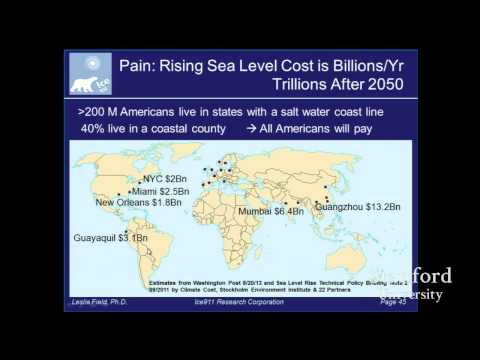
Sea levels are projected to rise 0.26-0.98 meters by 2100 under business-as-usual scenarios, with coastal cities already facing billions in annual adaptation costs:
-
New York City: $2 billion/year
-
Guangzhou, China: $13 billion/year
-
San Francisco Bay Area: Unspecified but rapidly escalating costs
-
-
Arctic summer sea ice has declined by 75% since 1980, with multi-year ice (the brightest and most reflective) almost completely gone.
-
The single greatest near-term climate risk is methane release from thawing permafrost, which could trigger an irreversible tipping point in the global climate system.
Module 2: Geoengineering – Risks and Rationale
-
Three primary responses to climate change:
-
Mitigation: Reducing greenhouse gas emissions (the only permanent solution)
-
Adaptation: Building resilience to existing and future impacts
-
Geoengineering: Deliberate large-scale modification of the Earth’s climate system (emergency backup only)
-
-
Two main categories of geoengineering:
-
Carbon Dioxide Removal (CDR): Removes CO₂ from the atmosphere (slow, expensive, unproven at scale)
-
Solar Radiation Management (SRM): Reflects sunlight to cool the planet (fast-acting but high risk)
-
-
Stratospheric sulfate aerosol injection is the most widely discussed SRM technique, mimicking volcanic eruptions to cool the planet. It could be deployed for less than $1 billion/year but carries catastrophic risks:
-
Disrupted global rainfall patterns
-
Increased mid-latitude storm severity
-
Irreversible commitment once started
-
No impact on ocean acidification
-
Module 3: The Ice 911 Project – Soft Geoengineering in Action
-
Field founded Ice 911 in 2006 after watching An Inconvenient Truth, with the goal of rebuilding the Earth’s "refrigerator" by restoring reflective Arctic ice.
-
The technology uses safe, biodegradable, reflective materials to increase the albedo of ice and water, slowing melt and allowing natural ice formation to accelerate.
-
Key design principles (developed over 7 years of volunteer research):
-
Reversible: Can be removed or allowed to biodegrade if unintended consequences occur
-
Ecologically respectful: Non-toxic, does not disrupt marine food chains
-
Low carbon footprint: Produces less CO₂ than it sequesters through reduced warming
-
Localized: Targets critical melt zones rather than the entire Arctic
-
-
Field testing has been conducted in Sierra Nevada lakes and a dedicated test pond in Minnesota, with results showing:
-
13°F cooler water temperatures compared to open water
-
Significantly slower ice melt in spring
-
Faster ice formation in fall
-
-
A breakthrough material discovered in 2013 is 1-2 orders of magnitude cheaper than previous options, making large-scale deployment economically feasible.
Module 4: Climate Entrepreneurship and Innovation
-
The climate crisis presents unprecedented entrepreneurial opportunities, with solutions needed across every sector of the economy.
-
The Cleantech Open is the world’s largest clean technology accelerator, supporting startups in energy, water, waste, green building, and agriculture.
-
2013 Cleantech Open winners included:
-
PowWow Energy: AI-powered water leak detection for agriculture
-
Helion Energy: Safe, scalable fusion energy
-
BioAdhesive Alliance: Sustainable adhesives made from swine manure
-
HJ3 Composite Technologies: Carbon nanotube reinforcement for aging infrastructure
-
-
Simple, low-tech solutions often have the greatest impact, as they can be deployed quickly and affordably in developing countries.
Module 5: Funding and Deployment Challenges
-
Ice 911 has operated on less than $200,000 in donations from friends and neighbors over 7 years, with no paid salaries.
-
Geoengineering research is chronically underfunded due to public fear and moral hazard concerns, even as the need for emergency options grows.
-
Planned funding strategies for Ice 911 include:
-
Crowdfunding and grassroots donations
-
Grants from climate-focused foundations
-
Corporate sponsorships and academic partnerships
-
Profitable commercial spin-offs using the cooling technology for non-climate applications
-
-
The first large-scale deployment is planned for April 2014 in Greenland, targeting glacial melt ponds with the help of local communities and polar explorer Doug Stoup.
Wishing you all the courage and creativity to tackle the defining challenge of our generation. The climate crisis is daunting, but every idea, every experiment, and every entrepreneur brings us one step closer to a sustainable future. Keep asking tough questions, collaborating across disciplines, and never stop believing that your work can change the world.