One. Course Details
This is a professional development course hosted by the Stanford Center for Professional Development, designed and delivered by Dr. Mark Zoback, the Benjamin Page Professor of Geophysics at Stanford University, and Dr. Arjun Kohli, Research Scientist and Lecturer in Stanford’s Department of Geophysics. The course is built around the instructors’ definitive 2019 textbook on unconventional reservoirs, and serves as a comprehensive deep dive into the geomechanics, engineering, and environmental stewardship of shale gas and tight oil development.
The curriculum is structured into three core sections, with content tailored for a diverse audience ranging from high school students to seasoned oil and gas industry professionals, including geophysicists, reservoir engineers, drilling operations teams, and environmental regulators. It combines first-principles geoscience theory, laboratory data, real-world case studies from major North American plays (the Permian Basin, Bakken, Marcellus, and Eagle Ford), and interactive assignments to build practical, actionable expertise. The course also builds on the instructors’ massively popular online Reservoir Geomechanics course, which has been completed by over 10,000 students worldwide.
Two. Key Learning Takeaways
-
The North American shale revolution, driven by horizontal drilling and multistage hydraulic fracturing, has transformed the U.S. energy landscape, cutting domestic CO₂ emissions dramatically via coal-to-gas fuel switching in power generation, and unlocking hydrocarbon resources on the scale of the world’s largest conventional oil fields.
-
Extremely low recovery factors are the industry’s biggest unresolved challenge: dry gas shale reservoirs see only ~25% recovery, while tight oil reservoirs average just 5% total recovery, leaving the vast majority of hydrocarbons in the ground despite massive increases in drilling and completion effort over the past decade.
-
Unconventional shale reservoirs have permeability a million times lower than conventional oil and gas reservoirs, meaning production is entirely dependent on creating and connecting permeable fracture networks via hydraulic stimulation.
-
The in-situ stress state (magnitude and orientation of subsurface stresses) is the single most important factor controlling hydraulic fracture orientation, propagation, and stimulation success – optimal well placement and completion design are impossible without accurate, high-resolution stress mapping.
-
Rock properties, including mineral composition, clay content, elastic anisotropy, viscoplastic deformation, and frictional stability, directly control every aspect of reservoir behavior, from fracture growth to production decline to induced seismicity risk.
-
Microseismic monitoring is a critical tool for understanding hydraulic fracture growth and shear stimulation of pre-existing faults, with the vast majority of stimulation-related microearthquakes being extremely low-magnitude (M-2), releasing energy equivalent to a gallon of milk falling off a kitchen counter.
-
Induced seismicity in the central and eastern U.S. is driven primarily by deep disposal of produced water, not hydraulic fracturing itself, and can be effectively mitigated by reducing injection volumes, as demonstrated in Oklahoma.
-
The vast majority of groundwater contamination associated with shale development stems from poor well construction and cementing, not hydraulic fracturing, which occurs thousands of feet below underground drinking water sources.
Three. Course Gold Quotes
-
"The three things to remember is well construction, well construction, and well construction."
-
"What's really been discovered is not the fact that there's oil or gas in a particular formation, but the technology that enables us to extract the hydrocarbons in an economic way."
-
"It's a reflection of the magnitudes of the in-situ stresses. You wanna know something about the stress magnitude and you wanna know something about the stress orientation to drill the wells in an optimal orientation."
-
"Cumulative production depends on both of these processes occurring: the hydraulic fracturing and the distributed shear on small faults."
-
"No earthquake has been induced by hydraulic fracturing that's ever caused any damage or injury."
-
"110 years ago people were kind of flummoxed by the complexity of these rocks, and it's still now in 2018 we're taking all the tools to bear to sort of figure out both the physical properties and also the stimulation process and recovery factors of these reservoirs."
-
"While a great deal of hydrocarbons is being produced, the fact of the matter is we are leaving the great majority of these hydrocarbons behind."
Four. Layered Learning Notes
Module 1: The Shale Revolution – Scale, Opportunity, and Industry Challenges
-
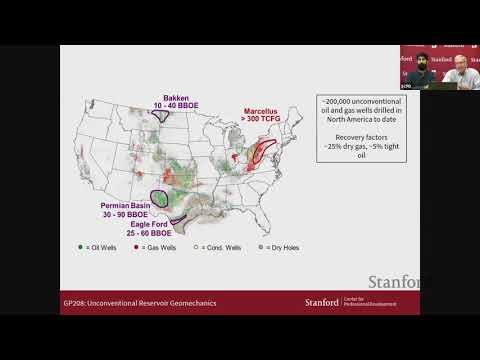
Transformative Industry Impact: Over the past 10 years, horizontal drilling and multistage hydraulic fracturing have unlocked massive hydrocarbon resources from previously uneconomic ultra-low permeability unconventional reservoirs across the U.S. and Canada. Just four major plays (Bakken, Marcellus, Eagle Ford, Permian Basin) produce hydrocarbons on par with the world’s largest conventional oil and gas fields, with ~200,000 wells drilled to date.
-
Environmental and Economic Benefits: The abundant, low-cost natural gas supply from shale plays has driven a massive shift in U.S. power generation from coal to natural gas, resulting in a dramatic, ongoing decline in domestic CO₂ emissions.
-
Core Industry Challenge: Low Recovery Factors: Despite the scale of the shale boom, recovery efficiency remains extremely low:
-
Dry gas shale reservoirs (e.g., Barnett Shale): ~25% total recovery, with 75% of gas left in the formation.
-
Tight oil reservoirs: 2-10% total recovery, with a 5% industry average.
-
-
Diminishing Returns on Completion Effort: Over the past decade, horizontal wells have gotten longer, with more hydraulic fracture stages and larger stimulation treatments. Despite this massive increase in operational effort, cumulative production per well has only increased modestly (50% in most plays, with the Marcellus as a standout at 2x improvement), creating significant economic and technical challenges for the industry.
-
Unlimited Future Drilling Potential: The Bureau of Economic Geology estimates up to 600,000 potential new wells across just five major U.S. plays, with up to 1 million additional wells in the Permian Basin alone due to multi-zone "stacked pay" opportunities. This creates an urgent need to improve recovery efficiency, optimize well design, and minimize environmental impacts for future development.
Module 2: Core Technology – Horizontal Drilling and Multistage Hydraulic Fracturing
-
Fundamental Technical Barrier: Unconventional reservoirs have permeability as low as 100 nanodarcys – a million times lower than conventional oil and gas reservoirs. Hydrocarbons cannot flow more than a few feet through the rock matrix, so economic production is entirely dependent on creating extensive, connected fracture networks.
-
Horizontal Drilling & Completion Design: The standard modern completion uses a 5,000 to 10,000 foot horizontal wellbore, cemented steel casing, and 30-40 sequential hydraulic fracture stages, isolated and pressurized from the toe of the well back to the heel.
-
Hydraulic Fracturing Fundamentals: Fractures propagate perpendicular to the direction of the minimum horizontal subsurface stress. Slickwater fracturing fluid allows pressure to leak out of the main hydraulic fracture, stimulating shear slip on thousands of pre-existing small faults and fractures in the reservoir.
-
Microseismic Monitoring: Each shear slip event generates tiny microearthquakes (typically magnitude -2), which are mapped to image the extent of the stimulated reservoir volume. These microseismic events reveal that low-viscosity slickwater fluid stimulates a far larger volume of the reservoir than high-viscosity gel fracturing fluid.
-
Dual Purpose of Stimulation: Effective reservoir stimulation requires two critical outcomes:
-
Creation of large, propped hydraulic fractures that connect the wellbore to the reservoir.
-
Distributed shear slip on pre-existing natural faults and fractures, which creates permeable pathways for hydrocarbons to flow from the ultra-low permeability rock matrix to the wellbore.
-
Module 3: Unconventional Reservoir Rock Properties – First Principles
The first section of the course focuses on the fundamental physical properties of shale reservoir rocks, which control every aspect of stimulation and production behavior:
-
Composition, Fabric, and Elastic Anisotropy: Unconventional reservoirs span a wide range of lithologies, from siliceous to clay-rich to calcareous, with dramatic compositional variations even over tens of meters. The course covers how mineralogy, organic content, and microstructure drive elastic anisotropy at all scales of the rock, which directly impacts seismic imaging, fracture growth, and well log interpretation.
-
Strength, Ductility, and Viscoplastic Deformation: Shale rocks deform viscoplastically (creep) under constant stress, with deformation rates varying dramatically based on composition and microstructure. This time-dependent deformation changes the in-situ stress state between rock layers, controlling whether hydraulic fractures grow vertically or horizontally, and whether they stay within the target hydrocarbon-bearing zone.
-
Frictional Properties and Slip Stability: The course breaks down the physics of fault slip, including the critical difference between velocity-strengthening (stable sliding, no microearthquakes) and velocity-weakening (unstable slip, microseismic potential) frictional behavior. Clay-rich rocks tend to be frictionally stable, while low-clay siliceous rocks are prone to unstable slip and microseismicity – a key factor in induced seismicity risk.
-
Pore Networks, Flow, and Sorption: The nanometer-scale pores in organic-rich shale create unique flow physics that are entirely different from conventional reservoirs. In the tiny pores of shale, gas molecules interact more with the pore walls than with each other, making diffusion the dominant flow mechanism rather than Darcy flow. The course covers how stress changes during depletion alter permeability, shift the balance between diffusive and Darcy flow, and drive long-term production decline.
Module 4: Reservoir Geomechanics and Stimulation Optimization
The second section of the course scales up from rock properties to full reservoir-scale geomechanics, with a focus on optimizing well design and stimulation:
-
Stress Mapping and Optimal Well Placement: The course uses new, high-resolution stress maps of major U.S. plays (Permian Basin, Marcellus/Utica) to demonstrate how stress orientation and magnitude vary spatially, even within a single basin. Optimal horizontal well orientation is directly controlled by the maximum horizontal stress direction, and must be adjusted to local stress variations to maximize stimulation effectiveness.
-
Hydraulic Fracture Growth Modeling: Advanced numerical modeling is used to simulate how fractures propagate through layered rock formations, and how operational variables (flow rate, proppant concentration, perforation design) can be adjusted to keep fractures within the target hydrocarbon zone, rather than propagating into non-productive overlying or underlying formations.
-
Depletion, Stress Changes, and Well Interference: As a well produces, pore pressure in the surrounding reservoir drops, altering the in-situ stress state. This creates a "depletion halo" around the well, which pulls hydraulic fractures from newly drilled infill wells toward the already depleted zone, rather than stimulating new, undrained reservoir rock. This "frac hit" phenomenon is a major industry challenge, leading to poor infill well performance and wasted stimulation effort.
-
Complex Stress Evolution: Depletion can cause dramatic, unpredictable changes in both stress magnitude and orientation, making hydraulic fracture growth highly variable in mature fields. The course teaches first-principles methods to predict these stress changes, and to optimize well spacing, sequencing, and completion design to avoid destructive well interference.
Module 5: Environmental Impacts, Induced Seismicity, and Risk Mitigation
The third section of the course addresses the environmental impacts of shale development, with a rigorous, data-driven focus on risk identification and mitigation:
-
Categorization of Environmental Impacts: The course breaks down impacts into four core categories: community impacts, atmospheric emissions, land use, and water use/protection. It emphasizes that the vast majority of shale operations are carried out safely, with no significant environmental harm, and that known risks can be effectively mitigated with proper engineering and operational practices.
-
Groundwater Protection: The single biggest driver of groundwater contamination is poor well construction, specifically inadequate cementing of the steel casing that isolates the wellbore from shallow underground drinking water sources. Hydraulic fracturing itself, which occurs thousands of feet below drinking water aquifers, is not a direct source of groundwater contamination in nearly all documented cases.
-
Induced Seismicity – Causes and Mitigation:
-
The dramatic increase in earthquakes in the central and eastern U.S. starting in 2009 is almost entirely driven by deep underground injection of produced water (water co-produced with oil and gas), not hydraulic fracturing.
-
Hydraulic fracturing generates only extremely small microearthquakes (M-2) in nearly all cases. The largest earthquakes linked to hydraulic fracturing have been magnitude 4, which are large enough to be felt but not large enough to cause structural damage or injury.
-
The reduction in injection volumes in Oklahoma directly led to a dramatic drop in induced seismicity events, proving that the risk can be effectively managed with targeted regulatory and operational changes.
-
-
Greenhouse Gas Emissions: The course addresses fugitive emissions from well construction and operation, and frames the critical role of natural gas as a bridge fuel in the U.S. energy transition, given its ability to displace coal-fired power generation and cut CO₂ emissions rapidly.
Wishing you every success as you deepen your expertise in reservoir geomechanics and unconventional resource development. May your studies unlock innovative solutions to boost recovery efficiency, minimize environmental impact, and drive responsible, sustainable energy development for years to come. Whether you’re in the lab, the field, or the boardroom, may your understanding of first-principles geoscience guide every successful project you take on.