1. Course Details
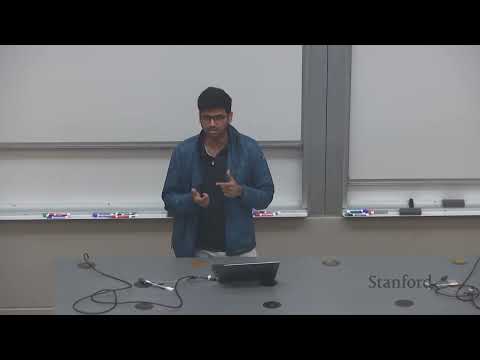
This is the 17th lecture of Stanford University's CS224R Deep Reinforcement Learning course, a guest lecture delivered by Ashish Kumar from the Tesla Optimus team. This lecture focuses on how reinforcement learning (RL) can be scaled to real-world robots through simulation-to-reality (sim-to-real) transfer, presenting groundbreaking results in legged locomotion, dexterous manipulation, and humanoid robotics.The lecture contrasts the core characteristics of successful imitation learning and reinforcement learning, explains the fundamental sim-to-real challenge, introduces the Rapid Motor Adaptation (RMA) algorithm for zero-shot real-world deployment, demonstrates how to integrate vision into end-to-end robot control, and concludes with progress on the Tesla Optimus humanoid robot and future research directions.2. Key Learning Objectives
By the end of this lecture, students will be able to:-
Compare and contrast the defining characteristics of successful imitation learning and successful reinforcement learning systems
-
Explain the two critical ingredients that enable large-scale reinforcement learning successes
-
Describe the core sim-to-real transfer problem and why naive domain randomization is insufficient
-
Implement the Rapid Motor Adaptation (RMA) algorithm for zero-shot real-world robot deployment
-
Design an end-to-end vision-based locomotion system that avoids explicit terrain mapping
-
Identify the key remaining challenges in scaling reinforcement learning to general-purpose humanoid robots
3. Memorable Quotes
-
"All of these successes still have these very two key ingredients which lets it succeed: well-specified rewards and the ability to run policies at scale."
-
"We can't reset the physical world to our own will, but we can convert a physical problem to a digital problem in simulation, which now just scales with compute."
-
"The exact same weights deployed zero shot in the real world without any tuning or specific improvement related to any of these terrains."
-
"Do we need terrain maps? We hypothesize that we don't. And instead, we directly couple vision and control in the final system."
-
"The day we achieve human parity in robotics will be a civilization-changing event. However, that will just be the first step in everything that we can achieve from robotics."
4. Detailed Lecture Notes
4.1 Imitation Learning vs. Reinforcement Learning: A Practical Comparison
The lecture opens with a grounded comparison of the two paradigms, focusing specifically on the characteristics of systems that have solved extremely hard real-world problems:表格| Characteristic | Successful Imitation Learning | Successful Reinforcement Learning |
|---|---|---|
| Data Source | Off-policy data collected by humans or unrelated sources | On-policy data generated by the policy being improved |
| Data Usage | Uses only curated, high-quality data | Uses all data generated during rollouts, both positive and negative |
| Output | Generalist models that can perform many tasks | Specialist models or specialized fine-tuning of generalist models |
| Key Strengths | Broad generalization, fast initial training | Precise, coherent behavior over long horizons; discovery of novel strategies |
4.2 The Two Pillars of Large-Scale RL Success
All major reinforcement learning breakthroughs share two non-negotiable ingredients:-
Well-specified, automatable rewards: The reward function must be clear, unambiguous, and computable at scale without human intervention. For AlphaGo, this is simply winning the game; for LLM reasoning, this is often rule-based evaluation.
-
Scalable policy execution: The ability to run millions of policy rollouts in parallel to generate massive amounts of training data. This is trivial in games and simulation, but has historically been the biggest barrier for real-world robotics.
4.3 The Sim-to-Real Solution for Robotics
The closest approximation to these two pillars for robotics is simulation:-
Simulation provides perfect state information, allowing programmatic reward calculation
-
Simulation scales perfectly with compute, enabling billions of training samples
-
The core challenge then becomes sim-to-real transfer: how to train policies in simulation that work reliably in the unforgiving physical world
4.4 Rapid Motor Adaptation (RMA) Algorithm
RMA is a breakthrough sim-to-real algorithm that enables zero-shot deployment of locomotion policies to the real world, with no fine-tuning required.Core Insight
Instead of training a single robust policy that is agnostic to environment variations, train a policy that explicitly conditions on a compressed vector of environment parameters called extrinsics. These extrinsics capture all relevant properties of the environment and robot state, such as mass, friction, payload, and terrain characteristics.Two-Phase Training Pipeline
-
Phase 1: Train the base policy in simulation
-
Randomize all physical parameters (mass, friction, damping, etc.) across a wide range
-
Give the policy access to the ground truth extrinsics vector
-
Train with PPO using a multi-component reward function:
-
Primary reward: Track target velocity
-
Secondary rewards: Minimize energy consumption, minimize ground impact, ensure stability
-
Hardware safety rewards: Prevent actions that would damage the robot
-
-
Requires approximately 1 billion training samples
-
-
Phase 2: Train the adaptation module with DAgger
-
The extrinsics vector is not directly observable in the real world
-
Train a separate adaptation module that estimates extrinsics from the robot's proprioceptive history (past actions and observations)
-
Use the DAgger algorithm:
-
Roll out the student adaptation module in simulation
-
Supervise every time step with the ground truth extrinsics from the teacher (Phase 1 policy)
-
Update the student module with supervised learning
-
Repeat until convergence
-
-
Deployment
-
The base policy runs at 100 Hz, controlling the robot's motors
-
The adaptation module runs at only 10 Hz, continuously updating the extrinsics estimate
-
This asymmetric frequency works surprisingly well and saves significant compute on board the robot
Experimental Results
The RMA policy demonstrates unprecedented robustness across diverse real-world terrains, all with the exact same weights:-
Rocks, stairs, grass, mud, sand, and construction sites
-
Slippery surfaces (oil-covered plastic)
-
Payloads up to 8 kg (67% of the robot's 12 kg body weight)
-
Uneven and unstable footholds
-
Robust domain randomization: Conservative, higher torque usage, lower success rate
-
Explicit system identification: Performs worse than even robust domain randomization, as precise parameter estimation is unnecessary and difficult
-
No adaptation: Catastrophic failure when encountering unexpected conditions
-
RMA: Outperforms all baselines by a significant margin, approaching expert performance
4.5 Adding Vision to RMA
While blind RMA is remarkably robust, vision is essential for two critical scenarios:-
Negotiating discrete obstacles like gaps, stepping stones, and jumps
-
Preventing unnecessary hardware wear from repeated collisions with the environment
The Flaw of Traditional Map-Based Approaches
Most vision-based locomotion systems first build an explicit metric map of the terrain, then feed this map into the controller. This approach has a fundamental flaw:-
Map building is an extremely hard problem that introduces unavoidable noise
-
Information is lost during the mapping process that could be useful for control
-
The controller must then be trained to be robust to map noise, which limits performance on precise tasks
End-to-End Vision-Control Integration
The RMA approach is extended to vision by:-
Training the base policy in simulation using perfect terrain height information
-
Training a depth encoder that maps real-world depth images to the same terrain representation used by the base policy
-
Using DAgger again to supervise the depth encoder with the teacher's terrain information
-
No explicit map building required
-
All information flows directly from perception to action
-
The policy learns to extract only the information relevant for control
-
Significantly outperforms map-based methods on challenging terrains with discrete obstacles
4.6 Generalization to Other Domains
The same RMA principles have been successfully applied to other robotic domains:-
Dexterous in-hand manipulation: A single policy that can rotate objects of vastly different shapes, weights, and friction coefficients, deployed zero-shot from simulation
-
Drone flight: A single policy that can control drones of different sizes, masses, and morphologies, with robust disturbance rejection
4.7 Tesla Optimus Humanoid Robot Progress
The lecture concludes with an update on the Tesla Optimus humanoid robot program:-
All behaviors are trained in simulation and deployed zero-shot to real hardware
-
The same pipeline that enabled quadruped locomotion is being scaled to humanoids
-
Current capabilities include bipedal walking on uneven terrain, dancing, and basic language-conditioned manipulation
-
Manipulation capabilities are trained using a combination of human egocentric videos and robot data
4.8 Remaining Challenges and Future Directions
While significant progress has been made, general-purpose humanoid robots still face two enormous challenges:-
Advanced simulation capabilities: Current simulation is good enough for rigid body locomotion, but cannot yet accurately simulate deformable objects, complex contact interactions, and material properties required for general manipulation
-
General reward models: Locomotion rewards are simple and universal, but manipulation tasks require task-specific reward functions. A general reward model that can understand and evaluate arbitrary human tasks remains an open problem.
These are my structured study notes and in-depth interpretations compiled by watching the open course. I hope this knowledge framework helps you thoroughly master the content of this subject. Wish you continuous academic progress and great achievements in your studies.