One. Course Details
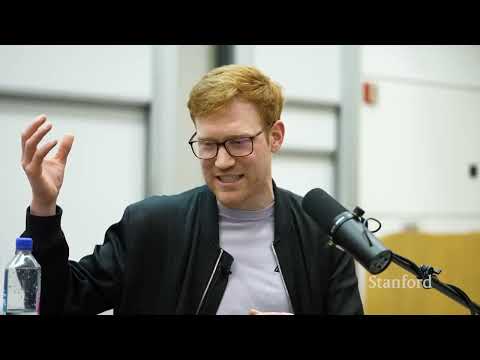
This is week three of CS 153: Frontier Systems (AI Coachella) at Stanford University, featuring guest speaker Andreas "Andy" Blattmann, co-founder of Black Forest Labs and co-creator of Stable Diffusion. Joining live from Freiburg, Germany—an emerging European hub for frontier AI research—Andy shares the remarkable story of building one of the most influential independent AI labs in the world from a small academic research group. The lecture traces the evolution of generative visual AI from early GANs to modern multimodal foundation models, explains the technical breakthroughs behind Stable Diffusion and FLUX, and outlines how visual intelligence will unlock the next wave of progress in physical AI, robotics, and world modeling.
The lecture covers:
-
Andy's journey from mechanical engineering to pioneering generative AI research
-
The invention of latent diffusion and the birth of Stable Diffusion in 2022
-
How a tiny team outcompeted Google and OpenAI with more efficient algorithms
-
The bootstrapping of the FLUX model flywheel and Black Forest Labs' explosive growth
-
The core theory of natural representations and why they are foundational to intelligence
-
The Self-Flow architecture for multimodal alignment and reasoning
-
The business case for open-source AI and sustainable commercialization
-
Future frontiers in physical AI, robotics, and unified multimodal models
-
Lessons on team culture, persistence, and navigating fast-changing technological landscapes
Two. Key Learning Takeaways
-
Natural representations (vision, audio) are the foundation of higher intelligence, not text. Humans learn by observing and interacting with the physical world long before they learn to read, and AI systems will follow the same path.
-
Efficiency is the ultimate competitive advantage for small teams. Black Forest Labs beat much larger competitors by developing algorithms that required orders of magnitude less compute to achieve state-of-the-art results.
-
Context feedback loops drive exponential capability growth. Observing how real users interact with your models reveals unsolved problems and clear paths for improvement that no internal research could predict.
-
Open source is not just a philosophy—it is a powerful commercial strategy. Open models capture massive market share in domains with diverse aesthetic preferences and customization needs, creating defensible network effects.
-
Unified multimodal models are the future. Training a single model on images, video, and audio together creates compounding intelligence gains that unimodal models cannot achieve.
-
Verification method defines commercialization strategy. Domains with objective verification (code, robotics) favor closed models, while domains with subjective preferences (art, content creation) favor open, customizable models.
-
Team culture and persistence are the most underrated moats. Black Forest Labs has had only one employee leave in its entire history, allowing it to maintain focus and execute faster than competitors with high turnover.
Three. Course Gold Quotes
-
"Text is inherently human made. Natural representations—vision and audio—are the fundamental signals we evolved to learn from. Starting AI with language is building a house from the roof down."
-
"We didn't have the compute Google and OpenAI had, so we had to be smarter. We invented latent diffusion to train models 10x more efficiently, and that changed everything."
-
"The most important capability no one thought we would solve was character consistency. Everyone said it was impossible—until we did it in 60 days with FLUX Kontext."
-
"Open source is not giving away your work for free. It is building the standard that everyone else will use, and then selling the premium services on top of that standard."
-
"You will have a million moments where it looks like the big guys have won. Don't panic. Stay focused on your users, iterate fast, and you will find your edge."
-
"We debate fiercely as a team, but once we make a decision, we all commit completely. That is how we went from zero to a $3 billion company in two years with 25 people."
-
"The future of AI is not just generating content. It is understanding the physical world and interacting with it. That is why visual intelligence is the most important frontier we have left to unlock."
Four. Layered Learning Notes
Module 1: Origins: From Mechanical Engineering to Generative AI
-
Andy began his career studying mechanical engineering in Germany, a classic technical education path that gave him a strong foundation in physics and systems thinking.
-
A series of coincidences led him to computer science and robotics, and he eventually pursued a PhD at the University of Heidelberg, where he met his co-founders Robin and Patrick.
-
In 2019, computer vision was still a niche field within AI. Most research focused on GANs for generating small 256x256 pixel images, and the broader AI community was obsessed with language models as the path to general intelligence.
-
The small Heidelberg lab competed directly with Google and OpenAI on generative visual research, despite having a tiny fraction of their compute resources. This constraint forced them to prioritize efficiency above all else.
-
The core insight: images are extremely high-dimensional and full of redundant information. Training generative models directly on pixel space is incredibly wasteful and computationally expensive.
Module 2: The Latent Diffusion Breakthrough and Stable Diffusion
-
Andy and his team spent two years developing latent generative modeling, a technique that first compresses images into a lower-dimensional latent space before training the generative model.
-
This approach is analogous to a learned JPEG codec: it preserves all the perceptual information that matters to humans while reducing computational requirements by orders of magnitude.
-
Latent diffusion allowed the team to train state-of-the-art image models with 10x less compute than their competitors, leveling the playing field against large tech companies.
-
In 2022, they released Stable Diffusion as an open-source model, which immediately became a global phenomenon.
-
The viral moment came when a Reddit user posted a crayon drawing of their child that had been transformed into a professional illustration using Stable Diffusion. This demonstrated that generative AI had crossed an inflection point of accessibility and utility for ordinary people.
-
Stable Diffusion's open-source nature spawned a massive ecosystem of developers, creators, and applications, cementing its position as the standard for generative image AI.
Module 3: Bootstrapping the FLUX Flywheel
-
After leaving Stability AI, Andy and his co-founders launched Black Forest Labs with a clear mission: to build the next generation of visual AI models.
-
They focused first on solving the most obvious pain point with existing image models: their inability to produce consistent characters and accurate details (like hands with five fingers).
-
The team leveraged their deep expertise in diffusion models to build FLUX.1, a next-generation image model that delivered a 10x improvement in quality and consistency over previous systems.
-
Even before the public API launch, large enterprise customers provided critical early feedback that closed the first iteration of the flywheel.
-
A key insight from user data: people were using FLUX.1 primarily to train LoRAs for character consistency, even though the model was not designed for this purpose.
-
This feedback led directly to the development of FLUX.1 Kontext, an image editing model that natively supports character consistency and precise control. The team reallocated resources and shipped Kontext in just 60 days.
-
Kontext was a massive commercial success, doubling revenue within six weeks and leading to a landmark partnership with Meta to power image editing for all 2 billion of its users. At the time, Black Forest Labs had only 25 employees.
Module 4: Natural Representations: The Foundation of Intelligence
-
Andy introduces a core philosophical distinction between two types of representations:
-
Natural representations: Vision, audio, and other signals that exist independently of human creation. These are the fundamental inputs we evolved to learn from.
-
Artificial representations: Text, code, and other human-invented systems designed for efficient communication.
-
-
Text is extremely information-dense and has no redundancy, which makes it great for communication but a poor foundation for general intelligence.
-
Natural representations are full of redundancy and correlation. For example, every physical action has an associated sound, and these correlations contain rich information about how the world works.
-
A three-year-old child has a far deeper understanding of the physical world than any language model, because they have learned through observing and interacting with natural representations.
-
The AI community made a mistake by prioritizing language models as the path to general intelligence. True general intelligence will emerge from models trained first on natural representations, with language added on top.
Module 5: Self-Flow and the Multimodal Revolution
-
The current generation of generative models are mostly unimodal: text-to-image, text-to-video, etc. The future lies in unified multimodal models that can understand and generate all types of natural representations together.
-
Training a single model on images, video, and audio creates compounding intelligence gains. The model learns cross-modal correlations that improve its performance on all individual tasks.
-
In March 2026, Black Forest Labs published Self-Flow, a breakthrough technique for aligning generative model representations with semantic understanding across multiple modalities.
-
Self-Flow solves the long-standing problem of making generative models "understand" what they are generating, rather than just producing visually consistent pixels.
-
The technique extends previous alignment work from single modalities to multimodal systems, enabling much more sophisticated reasoning and control.
-
Self-Flow has been widely adopted across the industry and is now the standard approach for training state-of-the-art multimodal generative models.
Module 6: Open Source vs. Closed: A Sustainable Business Model
-
There is a false trade-off between open-source AI and commercial success. Both are valid strategies that work best in different domains.
-
Open models excel in domains where preferences are diverse and subjective, such as art, design, and content creation. They allow users to customize the model to their specific tastes and needs.
-
Closed models excel in domains where verification is objective and preferences are narrow, such as code generation and customer support.
-
Black Forest Labs has built a sustainable business model around a tiered release strategy for FLUX:
-
FLUX Schnell: A fast 4-step model released under Apache 2.0 open-source license. It captured massive market share and built a huge developer ecosystem.
-
FLUX Dev: A higher-quality model released with a commercial license. Developers can use it for free but pay royalties if they generate revenue above a certain threshold.
-
FLUX Pro: The highest-quality model available exclusively through the Black Forest Labs API for enterprise customers.
-
-
This strategy allows the company to benefit from the network effects of open source while capturing revenue from high-value use cases.
-
A key principle: guardrails apply equally to everyone. No customer, no matter how large or powerful, gets special treatment or reduced safety restrictions. This builds trust and positions Black Forest Labs as a neutral infrastructure provider.
Module 7: Future Frontiers: From Content Creation to Physical AI
-
Generative visual AI has already transformed content creation, but this is just the beginning. The next wave of progress will be in physical AI and robotics.
-
Unified multimodal models trained on natural representations will enable robots to understand and interact with the physical world in ways that were previously impossible.
-
The training pipeline for these systems will follow three stages:
-
Pre-training: Large-scale unsupervised training on images, video, and audio to learn general world knowledge.
-
Mid-training: Adding conditioning for specific tasks, including predicting actions from observations.
-
Post-training: Deploying the model in the real world on robots, collecting interaction data, and closing the feedback loop.
-
-
Physical interaction provides the ultimate verification signal. The laws of physics impose hard constraints that eliminate the ambiguity of aesthetic preference.
-
Other promising frontiers include computer use (models that can operate software interfaces), world modeling and simulation, and immersive media.
-
Andy is skeptical of explicit 3D representations, arguing that humans do not have explicit 3D coordinate systems in their heads. Instead, we learn implicit spatial representations from video and interaction, and AI systems will do the same.
Module 8: Lessons for Student Founders and Researchers
-
Focus matters more than anything. When starting out, pick one specific problem and solve it better than anyone else. Don't try to do everything at once.
-
Stay extremely close to your users. They will show you the most important unsolved problems and give you the feedback you need to iterate quickly.
-
Embrace constraints. Limited compute and resources force you to be more creative and develop more efficient solutions than large teams with unlimited budgets.
-
Don't panic when competitors launch something impressive. There are always unsolved problems and opportunities to differentiate if you stay focused on your mission.
-
Build a strong team culture. Encourage open debate and dissent, but commit fully to decisions once they are made. A united team can outexecute much larger competitors.
-
Persistence is the most important trait. There will be many moments when it seems like all hope is lost, but the teams that keep going are the ones that succeed.
Wishing you all an incredible journey exploring the frontier of visual intelligence. This is one of the most exciting and dynamic fields in technology right now, and you have access to tools and knowledge that would have been unimaginable just a few years ago. Whether you want to build the next generation of generative art tools, develop intelligent robots, or push the boundaries of multimodal reasoning, the opportunities are endless. Don't be afraid to experiment, iterate quickly, and follow your curiosity. The future of how we see, create, and interact with the world is being written right now, and you all have a chance to be part of it.