One. Course Details
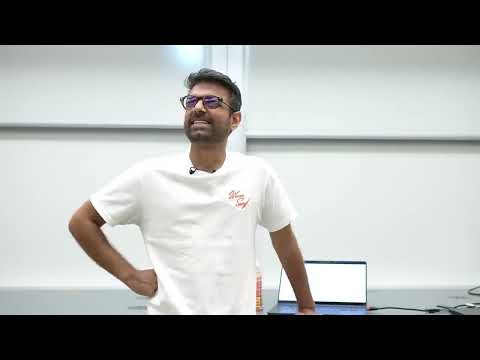
This is the opening lecture for CS 153: Frontier Systems at Stanford University, co-taught by Anjani "Anj" Mehta and Mike Schroepfer. Originally launched four years ago as "Security at Scale," the course has evolved dramatically to address the seismic shift in computing infrastructure driven by artificial intelligence. Anj, a Stanford alumnus, serial entrepreneur, and founding investor in over 10 leading AI labs including Anthropic, Mistral, and Black Forest Labs, delivers a candid, industry-insider perspective on the current state of AI infrastructure. The course features an unprecedented lineup of guest speakers from across the entire AI stack, including Jensen Huang (NVIDIA), Lisa Su (AMD), Satya Nadella (Microsoft), Sam Altman (OpenAI), and the co-creators of ChatGPT and Stable Diffusion.
The lecture covers:
-
The course philosophy and structure, including optional Friday virtual office hours for extra credit
-
Anj's personal journey and lessons learned from building and investing in AI companies
-
The seven-layer AI infrastructure stack from capital to governance
-
The critical role of context feedback loops in driving AI progress
-
The emerging compute scarcity crisis and its historical parallels
-
Why compute is no longer a commodity and what that means for the industry
-
Strategic advice for students looking to build careers in frontier AI
Two. Key Learning Takeaways
-
AI is triggering the most fundamental rewrite of computing infrastructure in 15 years. Every layer of the technology stack, from chips to governance, is being re-examined and redesigned.
-
Context is the new moat in AI. Teams with unique, defensible access to verifiable context will capture the most value, not just those with the most compute.
-
Compute is no longer a commodity. GPU prices are rising, not falling, and compute resources are not fungible, creating unprecedented scarcity and strategic competition.
-
Reinforcement learning (RL) is driving the next wave of AI progress. RL now consumes nearly as much compute as all other parts of the model training pipeline combined.
-
Sovereign AI is reshaping global cloud infrastructure. Governments and organizations with sensitive data are demanding local, controllable AI systems, creating opportunities for startups to challenge cloud oligopolies.
-
Infrastructure follows predictable boom-bust cycles. The current compute crunch mirrors historical cycles for steel, fiber optics, and uranium, and will eventually lead to standardization and commoditization.
-
Relationships and unique human insights are your greatest assets. In a world of scaling compute, the things that don't scale—obsession, taste, trust, and friendship—become your most powerful competitive advantages.
Three. Course Gold Quotes
-
"The most important people in this class aren't the speakers or the committee. It's you guys. Invest in these relationships because you won't realize how they'll help you in all kinds of ways later in life."
-
"Context is everything. Wherever in life we have verifiability, that's where progress will be fastest. Code is verifiable. Material science is verifiable. That's where you should be looking to build."
-
"Compute is not a commodity. Anyone who tells you otherwise hasn't tried to rent an H100 lately. Prices are going up, not down, and that changes everything."
-
"We are in the pre-standardization era of compute. Every new general-purpose technology goes through this phase—railroads, electricity, the internet. Now it's our turn."
-
"Take life seriously, but not so seriously that you forget what's important. Go to Coachella while you still can. The best heuristic I've found for success is to have fun with people you enjoy hanging out with."
-
"The great transition isn't just about technology. It's about transforming physical assets—land, power, chips—into software revenue that trades at 10x the multiple. That's the magic trade driving everything right now."
-
"There is no substitute for your unique taste and perspective. AI is terrible at aesthetics, beauty, and love. Those are the things that will make you irreplaceable."
Four. Layered Learning Notes
Module 1: Course Philosophy and Life Lessons
-
The course is nicknamed "AI Coachella" for its star-studded speaker lineup, but Anj emphasizes that it is fundamentally about preparedness for the real world, not just internships or grades.
-
Anj shares his personal scaling law for life: scale your impact by investing in relationships and doing things you love with people you enjoy.
-
He met his wife at Stanford as a sophomore and co-founded both of his companies with former roommates, highlighting the enduring value of college friendships.
-
A key piece of advice: be asymmetric in your bets. Large organizations struggle with things that don't scale, so your obsessions, taste, and personal relationships are your secret weapons.
-
The course will include optional Friday virtual office hours (noon–2 PM) for extra credit, featuring speakers who join remotely from around the world.
Module 2: The Seven-Layer AI Infrastructure Stack
Anj outlines the complete stack that powers modern AI, from the physical foundations to governance:
-
Capital: The flexible input that funds all other layers
-
Land, Power, and Shell: The physical infrastructure of data centers and energy production
-
Chips: The hardware that runs AI computations (NVIDIA GPUs, AMD accelerators)
-
Cloud Infrastructure: Software that makes chips usable at scale
-
Models/Agents: The AI systems trained on compute and data
-
Applications: End-user products built on top of models
-
Governance: Frameworks for safety, security, and responsible deployment
-
Four years ago, when the course started as "Security at Scale," this stack was relatively stable. Today, every layer is being completely rethought due to AI.
-
The course brings in speakers from every layer to provide a holistic view of the industry.
Module 3: Context Feedback Loops and Value Capture
-
The basic recipe for manufacturing intelligence remains simple: compute + data + algorithms. However, the process has evolved from a bespoke craft to an industrial engineering process.
-
Reinforcement learning (RL) is now the dominant driver of progress. RL post-training now consumes almost as much compute as base model training, and capabilities continue to scale with more compute and better context.
-
The critical insight: AI systems improve through closed feedback loops. When you deploy a model, you observe how it performs in the real world (context), feed that data back through RL, and the system gets better.
-
Verifiability is the key to fast progress. Domains where you can objectively measure success (coding, material science) will see exponential progress, while domains with subjective measures (aesthetics, creative writing) will progress more slowly.
-
The battle for context is already underway. OpenAI's attempted acquisition of the IDE Windsurf and Anthropic's subsequent shutdown of model access to Windsurf users was a clear signal that context is the most valuable asset in AI.
-
Sovereign AI is emerging as a major trend. Governments and organizations with sensitive data (national security, healthcare) are demanding local AI systems that they control, creating opportunities for open-source models like those from Mistral.
Module 4: The Compute Scarcity Crisis
-
Capabilities and revenue scale predictably with compute. Anj shows data from Anthropic demonstrating that every major compute buildout is followed 60–90 days later by a capabilities jump and a corresponding revenue jump.
-
This predictable trade has triggered an unprecedented infrastructure spending spree. The five largest tech companies will spend more on infrastructure in the next three years than they did in the preceding 30 years combined.
-
GPU prices are rising, not falling. An H100 that cost $1.73 per hour two years ago now costs significantly more, and prices continue to climb.
-
This defies the fundamental assumption that chips are commodities that depreciate over time. The entire cloud industry was built on this assumption, and it is now breaking down.
-
Anj draws historical parallels to previous infrastructure booms: steel (1867–1895), fiber optics (1990s), and uranium (1970s). All followed a similar pattern:
-
Invention of a transformative technology
-
Hoarding and price spikes
-
Panic and market crash
-
Standardization and stabilization
-
-
Compute is not fungible. Different chips from the same manufacturer (H100 vs. GB200 vs. B300) are not interchangeable, and forecasting compute needs is extremely difficult due to the spiky nature of training runs.
Module 5: The Path Forward: Standardization and Public Benefit
-
We are currently in the pre-standardization era of compute. Every new general-purpose technology goes through this phase before industry or government establishes common standards.
-
For compute to become a true commodity, we need:
-
Common units of measurement
-
Standard delivery interfaces
-
Interconnection and pooling mechanisms
-
Metering, control, and settlement systems
-
-
Institutions will be needed to enforce these standards and ensure that compute resources are allocated for public benefit, not just hoarded by large corporations.
-
Anj challenges students to think about what these standards should look like and what role they can play in shaping them.
Module 6: Advice for Students
-
You are extraordinarily lucky to be alive right now. This is one of the most exciting and transformative moments in human history, and you have a front-row seat.
-
Don't just be a spectator. Be an active participant in shaping the future of AI and computing infrastructure.
-
Leverage your unique advantages: your youth, your curiosity, your relationships, and your unique perspective on the world.
-
The best projects will combine technical excellence with a deep understanding of a specific domain or context.
-
The grand prize for the best final project last year was a signed NVIDIA RTX 5090, and there may be similar surprises this year.
Wishing you all an incredible quarter exploring the frontier of AI systems. This is a once-in-a-generation moment to be part of building the technology that will define the 21st century. Whether you're drawn to hardware, software, models, or governance, there has never been a better time to be a computer scientist. Embrace the uncertainty, ask the hard questions, build meaningful relationships, and don't forget to have fun along the way. The future is not something that happens to you—it's something you build. Go out there and make it amazing.