One. Course Details
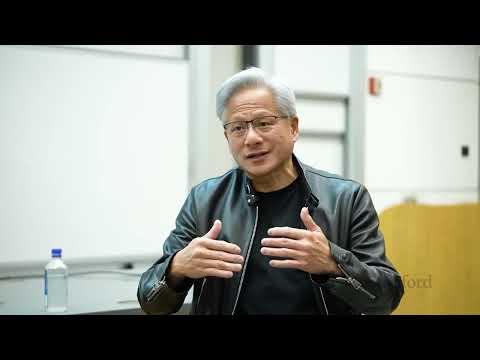
This is week seven of CS 153: Frontier Systems (AI Coachella) at Stanford University, featuring returning guest Jensen Huang, founder and CEO of NVIDIA, affectionately nicknamed "Preacher Huang" for his ability to inspire and evangelize the future of computing.
Jensen delivers a sweeping lecture on the most fundamental transformation in computing in 64 years, explains how NVIDIA's full-stack code design approach delivered a million-fold performance improvement over a decade, and reveals the roadmap for future AI chips built for agentic systems. He also shares brutally honest lessons from NVIDIA's near-death experiences and biggest strategic mistakes, offers unfiltered career advice for students, and addresses controversial topics including AI regulation, compute scarcity, and open source AI.
The lecture covers:
-
The paradigm shift from pre-recorded to generative, continuous computing
-
The principles and power of full-stack code design
-
NVIDIA's chip roadmap through the Feynman generation
-
The future of AI education and university compute infrastructure
-
NVIDIA's open source AI strategy and philosophy
-
Common myths about compute utilization and performance metrics
-
Hard-earned lessons on strategy, failure, and resilience
-
The energy future of AI computing
-
AI policy and the global technology competition
Two. Key Learning Takeaways
-
Computing is undergoing its most fundamental transformation since the IBM System 360 in 1964. For 64 years, the computing model remained largely unchanged, but AI has rewritten every layer of the stack from hardware to software to applications.
-
Full-stack code design delivers exponential performance gains that far outpace Moore's Law. By co-optimizing chips, systems, networking, software, and algorithms together, NVIDIA achieved 1 millionx performance improvement over 10 years, compared to just 10x from traditional semiconductor scaling alone.
-
Agentic computing is the next major paradigm shift. Future computers will run continuously rather than only on demand, requiring completely new architectures optimized for long memory, low-latency tool use, and multi-agent coordination.
-
Open source AI is essential for democratization, safety, and domain-specific innovation. Closed source models are great for general purpose use, but open models are necessary to advance science, support underrepresented languages, and build secure, auditable systems.
-
Compute scarcity in universities is a systemic budgeting problem, not a supply problem. The solution is not more individual grants, but centralized investment in campus-wide supercomputers that all researchers and students can share.
-
Success requires embracing struggle and resilience. Don't wait to find your passion—do excellent work even when it's hard, because suffering builds the character you will need to lead through difficult times.
-
AI singularity doomsday narratives are irresponsible science fiction. All AI systems are understandable and controllable, and comparing GPUs to nuclear weapons is a dangerous and false analogy.
Three. Course Gold Quotes
-
"For 64 years, computing has been largely the same since the IBM System 360. Today, everything is fundamentally different."
-
"Moore's Law gave us 10x every five years. Code design gave us one millionx over ten years. That's the difference that made AI possible."
-
"Computing as we knew it before was largely pre-recorded. Now everything is generated, contextually relevant, and responsive to your intention—not just your explicit instructions."
-
"If you want AI to be safe and secure, it has to be open. You cannot defend against a black box, and you cannot secure something you cannot inspect."
-
"Ninety percent of my work is hard and I suffer through it. But that ten percent makes all the suffering worth it. Struggle builds resilience, and resilience is what you need when the world needs you to be tough."
-
"Comparing Nvidia GPUs to atomic bombs is stupid. There are a billion people with Nvidia GPUs. I recommend them to my family and my kids. I don't recommend atomic bombs to anyone."
-
"The biggest mistake I ever made was chasing the mobile market. We built a billion-dollar business and then lost it all overnight. But that failure taught us energy efficiency, which now powers every AI chip we make."
Four. Layered Learning Notes
Module 1: The End of General Purpose Computing
-
The computing model that defined the industry for 64 years, from mainframes to cloud computing, was based on pre-recorded software—programs written by humans that executed predefined instructions.
-
AI has completely overturned this model. Today, software is generated in real time, contextually relevant to the user, and capable of reasoning and acting on intention rather than just explicit commands.
-
The next evolution of this shift is continuous computing. Today's cloud is on-demand—you spin up resources when you need them. Tomorrow's agentic systems will run 24/7, working in the background to accomplish goals without human initiation.
-
This paradigm shift affects every layer of the technology stack: how we design chips, how we write software, how we organize companies, and what computers are even used for.
-
Applications that were impossible just a few years ago—fully autonomous vehicles, general purpose humanoid robots, real-time climate simulation—are now becoming feasible because of this fundamental change in how computing works.
Module 2: The Power of Full-Stack Code Design
-
Code design (or co-design) is the principle of optimizing all layers of a system together rather than optimizing each layer in isolation.
-
The classic example of code design is John Hennessy's RISC architecture at Stanford. Instead of building a more complex processor, RISC simplified the instruction set to make compilers more effective, resulting in better overall performance than either component could have achieved alone.
-
NVIDIA took this principle to an extreme. The company co-designs CPUs, GPUs, networking switches, storage systems, software frameworks, and algorithms as a single integrated system.
-
This approach delivered a one million-fold performance improvement over the past decade, which is what made large language models possible. Without this level of acceleration, training models on the entire internet would have been economically and technically impossible.
-
The lesson is that for extreme computational problems like deep learning, general purpose computers will never be competitive with systems designed end-to-end for the specific workload.
Module 3: The Future of AI Education
-
Traditional textbooks cannot keep up with the pace of AI development. Knowledge is now generated in real time, and textbooks are outdated by the time they are printed.
-
The future of education is a union of first principles and AI-assisted learning. Students should learn the fundamental concepts of computer science, then use AI as a super researcher to explore the latest developments.
-
Jensen revealed that he cannot learn effectively without AI today. He uses AI to read and summarize research papers, ask follow-up questions, and connect ideas across different fields.
-
However, first principles are still critically important. Conway's Law, Amdahl's Law, and the fundamentals of semiconductor design are as relevant today as they ever were.
-
The best education combines theoretical knowledge with real-world practice. Jensen worked at AMD designing microprocessors while taking classes at Stanford, and this combination of theory and practice taught him more than either could have alone.
Module 4: NVIDIA's Open Source AI Strategy
-
NVIDIA uses both closed source frontier models (OpenAI, Anthropic) internally for engineering work, because they are currently the most capable tools available.
-
However, the company is investing heavily in open source models for three key reasons:
-
Domain-specific innovation: General purpose language models are not sufficient for science. NVIDIA is building open foundation models for biology (Bioneo), autonomous vehicles (Alpamo), robotics (Groot), and climate science.
-
Language diversity: Commercial companies will never prioritize building high-quality models for all 230+ languages in the world. Open source models allow communities to fine-tune models for their own languages.
-
Safety and security: Open systems are auditable and defensible. The best way to defend against malicious AI is to have millions of researchers working on security, not just a small team inside a closed company.
-
-
NVIDIA's Neotron model is near-frontier performance and fully open, designed to be a foundation that the entire ecosystem can build on.
Module 5: Compute Metrics and Utilization Myths
-
Model Flops Utilization (MFU) is a misleading metric that is widely misused in the industry. A low MFU does not necessarily mean a system is inefficient.
-
For large language model inference, the bottleneck is not compute flops—it is memory bandwidth. Decoding tokens requires moving massive amounts of data, not performing calculations.
-
The correct metric for AI systems is tokens per watt, not flops per second. NVIDIA's Grace Blackwell architecture delivers 50x better tokens per watt than the previous generation, despite having much lower MFU during inference.
-
Overprovisioning is actually a feature, not a bug. If you provision for peak load rather than average load, you will have idle resources most of the time, but you will avoid catastrophic slowdowns during critical periods.
-
The industry's obsession with high MFU leads to bad architectural decisions that optimize for the wrong thing, resulting in worse real-world performance and higher total cost of ownership.
Module 6: NVIDIA's Chip Roadmap for Agentic AI
-
NVIDIA designs chips three generations ahead, based on its best guess of what computing patterns will look like 5-10 years in the future.
-
Hopper: Designed for pre-training large language models. When it was designed, there were no customers for billion-dollar supercomputers, but NVIDIA bet on first principles that AI would scale exponentially.
-
Grace Blackwell: Designed for inference and token generation. It introduced NVLink 72, which gangs 72 chips together to provide the massive memory bandwidth required for decoding.
-
Vera Rubin: Currently in development, designed specifically for agentic systems. It features a new high-performance, low-latency CPU optimized for tool use, and direct storage access for long-term memory.
-
Feynman: The next generation after Vera Rubin, designed for systems of agents. It will be optimized for swarms of millions of small agents working together to solve complex problems.
Module 7: Energy and the Future of Computing
-
The single most important thing NVIDIA can control is energy efficiency. The company has improved tokens per watt by 50x in two years and will continue to drive this improvement exponentially.
-
However, even with these efficiency gains, Jensen estimates that the world will need 1000 times more compute energy than it has today to fully realize the potential of AI.
-
This is not a crisis—it is an enormous opportunity. For the first time in history, market forces alone are sufficient to drive massive investment in sustainable energy.
-
Government subsidies are no longer necessary for solar, wind, or nuclear power. The demand from AI data centers will create a market that will pay for the transition to clean energy on its own.
-
This is also the best chance we have ever had to upgrade the world's archaic electrical grid, which has barely changed in 50 years.
Module 8: Career Advice and Lessons from Failure
-
The common advice to "follow your passion" is overrated and sets unrealistic expectations. Most people do not know what they are passionate about when they are young.
-
Instead of chasing passion, chase excellence. Do the best job you possibly can at whatever you are doing, even if it is not your dream job. Excellence will open doors that you cannot see today.
-
Embrace struggle and suffering. Ninety percent of every job is hard work that no one enjoys. But going through difficult times builds resilience, which is the most important trait for a leader.
-
Jensen shared NVIDIA's two biggest failures:
-
The first generation of NVIDIA graphics cards was technically completely wrong. The company used curved surfaces instead of triangles and forward texture mapping instead of inverse texture mapping.
-
The company wasted years chasing the mobile market, building a billion-dollar business that was completely wiped out during the 3G to 4G transition.
-
-
However, both failures ultimately led to greater success. The first failure taught Jensen the importance of strategy over pure technology. The mobile failure taught NVIDIA how to build extremely energy-efficient chips, which is now its greatest competitive advantage in AI.
Module 9: AI Policy and Compute Access
-
Jensen strongly rejected the analogy between GPUs and nuclear weapons. GPUs are general purpose tools used for video games, medical imaging, scientific research, and AI. They benefit billions of people every day.
-
He also rejected the idea that American companies should concede global markets to competitors. Competition makes companies stronger and benefits consumers around the world.
-
On the issue of compute scarcity in American universities, Jensen argued that the problem is not supply—it is budgeting. Universities have decentralized budgets where individual departments buy small clusters that are mostly idle.
-
The solution is for universities to build centralized campus-wide supercomputers, similar to the linear accelerators that Stanford built in the past. A single billion-dollar supercomputer would be far more useful than a thousand small clusters.
-
Jensen committed that if Stanford places an order for a billion-dollar supercomputer, NVIDIA will deliver it immediately.
Wishing you all the courage to tackle the hardest problems, the curiosity to question every assumption, and the resilience to turn your failures into your greatest strengths. The AI revolution is just beginning, and the most important breakthroughs will not come from big companies alone—they will come from students like you who are willing to think differently and build fearlessly. Don't be afraid to suffer through the hard parts; that's where the real magic happens. Go build something amazing, and never stop learning. The future is yours to create.