





 Note Wisdom
Under the Sea - Amazing Ocean Animals: Exploring the Deep Blue and Its Wonderful Creatures
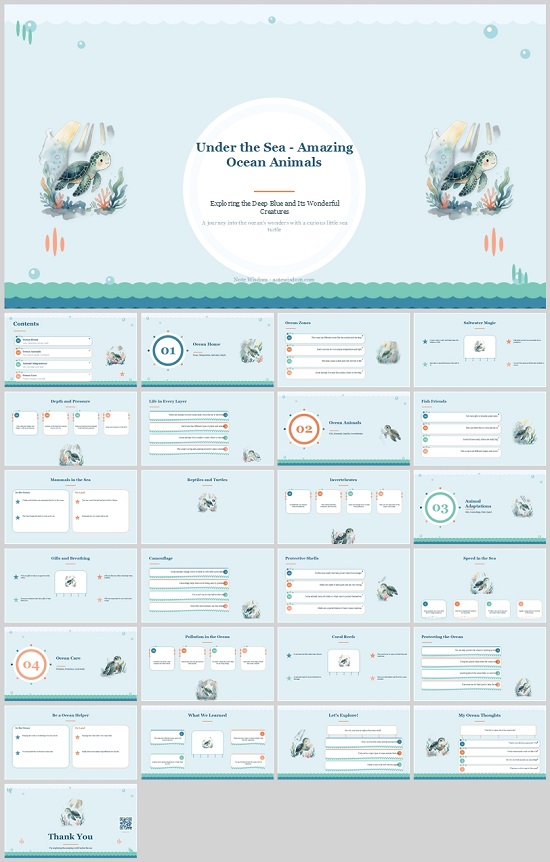
This pastel-themed ocean animal presentation template uses charming watercolor illustrations to teach young children about marine biology and conservation. It offers a structured, engaging slide-by-slide plan to help educators discuss ocean zones, animal
- Download this PPT
- Commercial use (1 project)
- Present publicly
1. PPT Title
Under the Sea - Amazing Ocean Animals: Exploring the Deep Blue and Its Wonderful Creatures
2. Design Concept
Core design philosophy: "Aquatic Wonder & Gentle Discovery" – Using soothing pastel tones and charming watercolor illustrations to create a safe, magical, and engaging learning environment that sparks curiosity about marine life.
-
1. Color System:
-
Primary: Soft Pastel Blue (#D9E8F5) for backgrounds to evoke calm ocean waters.
-
Secondary: Teal/Seafoam Green (#4A90A4) and Crisp White (#FFFFFF) for content boxes, borders, and wave accents.
-
Tertiary: Coral/Peach (#F2A68D) for highlights, circular badges, and small accents.
-
-
2. Visual Elements: Watercolor-style illustrations (sea turtle, coral reefs, seaweed, fish), wavy borders, bubbles, dotted connecting lines, circular numbered badges (01, 02, 03, 04), and clean, rounded rectangular text cards.
-
3. Layout & Typography:
-
Layout: Symmetrical title slide with centered text. Clean, grid-based, airy content slides with generous white space. Left-aligned or split-screen text blocks paired with corresponding illustrations.
-
Typography: Elegant serif fonts (e.g., Playfair Display) for titles to evoke a storybook feel; clean, rounded sans-serif fonts (e.g., Nunito, Quicksand) for body text to ensure readability for early readers.
-
-
4. Design Goal: To provide a structured, visually soothing educational tool that introduces young children to marine biology, ocean habitats, and environmental conservation in a fun, accessible way.
-
Conclusion: A beautifully designed, ocean-themed presentation template that perfectly balances scientific facts with a whimsical, child-friendly aesthetic, making it an ideal choice for early childhood science education.
3. Slide-by-Slide Outline
Slide 1: Title Slide
-
Title: Under the Sea - Amazing Ocean Animals
-
Key Content: Main title, subtitle ("Exploring the Deep Blue and Its Wonderful Creatures"), and a short descriptive tagline.
-
Layout Suggestion: Center-aligned text. Decorative wavy borders at the top and bottom.
-
Image/Icon Suggestion: Two watercolor sea turtles swimming near coral on either side of the title, with bubbles and small fish.
Slide 2: Contents / Agenda
-
Title: Our Ocean Journey
-
Key Content: List of four main sections (01 Ocean Home, 02 Ocean Animals, 03 Animal Adaptations, 04 Ocean Care).
-
Layout Suggestion: Vertical list on the left with teal rounded badges for each number. A small sea turtle illustration at the bottom right.
-
Image/Icon Suggestion: Small watercolor icons (a wave, a fish, a shell, a heart) next to each section.
Slide 3: Section 01 Divider
-
Title: 01 Ocean Home
-
Key Content: Transition slide introducing the ocean environment.
-
Layout Suggestion: Large central circular badge with "01" inside. Title below with a dotted underline.
-
Image/Icon Suggestion: A cute watercolor sea turtle swimming through seaweed.
Slide 4: Ocean Home
-
Title: Ocean Home
-
Key Content: Introduction to the ocean as a vast habitat covering most of the Earth.
-
Layout Suggestion: Text on the left, a large illustration card on the right.
-
Image/Icon Suggestion: Watercolor scene of a vibrant coral reef with various fish.
Slide 5: Ocean Zones
-
Title: Ocean Zones
-
Key Content: The different layers of the ocean (Sunlight, Twilight, Midnight zones).
-
Layout Suggestion: A vertical diagram or three horizontal cards with rounded corners.
-
Image/Icon Suggestion: Watercolor illustration showing the transition from light blue surface to dark blue deep sea.
Slide 6: Saltwater Magic
-
Title: Saltwater Magic
-
Key Content: Why the ocean is salty and how animals survive in saltwater.
-
Layout Suggestion: Split screen. Left side has text bullets; right side has a large illustration card.
-
Image/Icon Suggestion: Watercolor sea turtle swimming near a salt crystal or a wave.
Slide 7: Depth and Pressure
-
Title: Depth and Pressure
-
Key Content: How deep the ocean is and how animals adapt to high pressure.
-
Layout Suggestion: Three horizontal cards with rounded corners.
-
Image/Icon Suggestion: Watercolor icons of a submarine, a deep-sea fish, and a pressure gauge.
Slide 8: Life in Every Layer
-
Title: Life in Every Layer
-
Key Content: Exploring the biodiversity found at different depths of the ocean.
-
Layout Suggestion: A grid of four small illustration cards with captions.
-
Image/Icon Suggestion: Watercolor sea creatures from different zones (jellyfish, whale, anglerfish, crab).
Slide 9: Section 02 Divider
-
Title: 02 Ocean Animals
-
Key Content: Transition slide introducing the diversity of marine life.
-
Layout Suggestion: Large central circular badge with "02" inside.
-
Image/Icon Suggestion: A watercolor dolphin jumping out of the water.
Slide 10: Fish Friends
-
Title: Fish Friends
-
Key Content: Characteristics of fish (scales, fins, cold-blooded).
-
Layout Suggestion: Three horizontal cards with rounded corners.
-
Image/Icon Suggestion: Watercolor tropical fish, a goldfish, and a shark.
Slide 11: Mammals in the Sea
-
Title: Mammals in the Sea
-
Key Content: Ocean mammals (whales, dolphins) that breathe air and feed their young milk.
-
Layout Suggestion: Split screen. Left side has text bullets; right side has a large illustration card.
-
Image/Icon Suggestion: Watercolor whale and dolphin swimming together.
Slide 12: Reptiles and Turtles
-
Title: Reptiles and Turtles
-
Key Content: Sea turtles and other reptiles that live in the ocean.
-
Layout Suggestion: A grid of four small illustration cards with captions.
-
Image/Icon Suggestion: Watercolor sea turtle, sea snake, and marine iguana.
Slide 13: Invertebrates
-
Title: Invertebrates
-
Key Content: Animals without backbones (jellyfish, octopus, starfish).
-
Layout Suggestion: Split screen. Left side has text bullets; right side has a large illustration card.
-
Image/Icon Suggestion: Watercolor jellyfish, octopus, and starfish.
Slide 14: Section 03 Divider
-
Title: 03 Animal Adaptations
-
Key Content: Transition slide introducing how animals survive in the ocean.
-
Layout Suggestion: Large central circular badge with "03" inside.
-
Image/Icon Suggestion: A watercolor crab hiding in a shell.
Slide 15: Gills and Breathing
-
Title: Gills and Breathing
-
Key Content: How fish use gills to breathe underwater.
-
Layout Suggestion: Split screen. Left side has text bullets; right side has a large illustration card.
-
Image/Icon Suggestion: Watercolor close-up of a fish's gills or a fish breathing underwater.
Slide 16: Camouflage
-
Title: Camouflage
-
Key Content: How animals blend into their surroundings to hide from predators.
-
Layout Suggestion: Three horizontal cards with rounded corners.
-
Image/Icon Suggestion: Watercolor octopus changing color, a flatfish on the ocean floor.
Slide 17: Protective Shells
-
Title: Protective Shells
-
Key Content: Animals that use hard shells for protection (turtles, crabs, mollusks).
-
Layout Suggestion: A grid of four small illustration cards with captions.
-
Image/Icon Suggestion: Watercolor sea turtle, hermit crab, clam, and snail.
Slide 18: Speed in the Sea
-
Title: Speed in the Sea
-
Key Content: Fastest swimmers in the ocean (sailfish, marlin, dolphins).
-
Layout Suggestion: Split screen. Left side has text bullets; right side has a large illustration card.
-
Image/Icon Suggestion: Watercolor sailfish or dolphin swimming fast with speed lines.
Slide 19: Section 04 Divider
-
Title: 04 Ocean Care
-
Key Content: Transition slide introducing conservation and protecting the ocean.
-
Layout Suggestion: Large central circular badge with "04" inside.
-
Image/Icon Suggestion: A watercolor sea turtle swimming near a piece of plastic or a clean-up net.
Slide 20: Pollution in the Ocean
-
Title: Pollution in the Ocean
-
Key Content: How plastic and trash harm marine life.
-
Layout Suggestion: Three horizontal cards with rounded corners.
-
Image/Icon Suggestion: Watercolor icons of a plastic bottle, a plastic bag, and a sad sea turtle.
Slide 21: Coral Reefs
-
Title: Coral Reefs
-
Key Content: The importance of coral reefs and why they are in danger.
-
Layout Suggestion: Split screen. Left side has text bullets; right side has a large illustration card.
-
Image/Icon Suggestion: Watercolor vibrant coral reef with fish, and a bleached coral reef.
Slide 22: Protecting the Ocean
-
Title: Protecting the Ocean
-
Key Content: What we can do to help (reduce plastic, recycle, clean up beaches).
-
Layout Suggestion: A grid of four small illustration cards with captions.
-
Image/Icon Suggestion: Watercolor icons of a recycling bin, a reusable bag, a beach clean-up, and a happy sea creature.
Slide 23: Be an Ocean Helper
-
Title: Be an Ocean Helper
-
Key Content: A pledge or call to action for kids to protect the ocean.
-
Layout Suggestion: Two distinct blocks: "At Home" and "At School".
-
Image/Icon Suggestion: Watercolor child wearing a cape or holding a "Save the Ocean" sign.
Slide 24: What We Learned / Let's Explore!
-
Title: What We Learned / Let's Explore!
-
Key Content: Summary of the presentation and an interactive quiz or activity.
-
Layout Suggestion: Two distinct blocks: "What We Learned" (three circular badges) and "Let's Explore!" (checklist).
-
Image/Icon Suggestion: Small watercolor icons of a fish, a turtle, a wave, and a magnifying glass.
Slide 25: Thank You
-
Title: Thank You!
-
Key Content: Closing message, thank you to the audience, and contact/QR code.
-
Layout Suggestion: Centered text with a large illustration.
-
Image/Icon Suggestion: The watercolor sea turtle waving goodbye, surrounded by bubbles and coral.
4. Speaker Notes
-
Slide 1: "Welcome, ocean explorers! Today, we are going to dive deep under the sea to discover some of the most amazing animals on our planet. Our friendly sea turtle is here to guide us!"
-
Slide 2: "Here is our map for today. We will learn about the ocean home, meet the animals that live there, discover their amazing adaptations, and learn how we can protect them."
-
Slide 3: "Let's start with our first section: Ocean Home. The ocean is a vast and magical place that covers most of our Earth."
-
Slide 4: "The ocean is home to millions of creatures. It's like a giant underwater city full of colorful coral and fascinating fish."
-
Slide 5: "The ocean has different layers, just like a cake! There is the sunny top layer, the twilight middle layer, and the dark, deep midnight layer where it's very cold."
-
Slide 6: "Did you know the ocean is salty? It's not like the water we drink. Animals like sea turtles have special ways to get rid of the extra salt so they can survive."
-
Slide 7: "The deeper you go, the more pressure there is. It's like being squeezed by a giant hand! But deep-sea animals have special bodies to handle it."
-
Slide 8: "Even in the darkest, deepest parts of the ocean, there is life. Animals like the anglerfish use glowing lights to find food and friends!"
-
Slide 9: "Now, let's move to our second section: Ocean Animals. There are so many different kinds of animals in the sea!"
-
Slide 10: "Fish are the most common animals in the ocean. They have scales and fins, and they use gills to breathe underwater."
-
Slide 11: "But not all ocean animals are fish. Whales and dolphins are mammals, just like us! They breathe air and feed their babies milk."
-
Slide 12: "Sea turtles are reptiles. They have hard shells to protect them, and they have to come up to the surface to breathe air."
-
Slide 13: "Some ocean animals don't have bones at all! Jellyfish, octopuses, and starfish are called invertebrates. They are soft and squishy."
-
Slide 14: "Our third section is all about Animal Adaptations. How do these animals survive in their watery world?"
-
Slide 15: "Fish have gills that pull oxygen out of the water, so they can breathe without coming up for air like we do."
-
Slide 16: "Camouflage is a superpower! Many ocean animals can change color or blend into the sand and rocks to hide from predators."
-
Slide 17: "Some animals, like turtles and crabs, have hard shells. When they feel scared, they can hide inside to stay safe."
-
Slide 18: "Some fish are incredibly fast! The sailfish can swim as fast as a car drives on the highway."
-
Slide 19: "Finally, let's talk about Ocean Care. It's up to us to keep the ocean clean and safe for all these amazing animals."
-
Slide 20: "Sadly, a lot of plastic ends up in the ocean. This can hurt the animals who mistake it for food. We need to reduce our plastic use."
-
Slide 21: "Coral reefs are like the rainforests of the sea. They are home to many fish, but they are in danger because of warming waters and pollution."
-
Slide 22: "We can all help! By recycling, using reusable bags, and picking up trash at the beach, we can make a big difference."
-
Slide 23: "You can be an ocean helper! At home, you can turn off the tap when brushing your teeth. At school, you can teach your friends about recycling."
-
Slide 24: "Wow, we learned so much today! We learned about the ocean zones, amazing animals, and how to protect them. Now, let's try a fun activity! Can you name one animal we met today?"
-
Slide 25: "Thank you for joining me on this underwater adventure! Remember to be kind to our ocean and all the creatures that live in it. Goodbye, friends!"
Article + Bundle Download