






 Note Wisdom
Plants_and_Nature_Around_Us_-_A_2nd_Grade_Science_Lesson
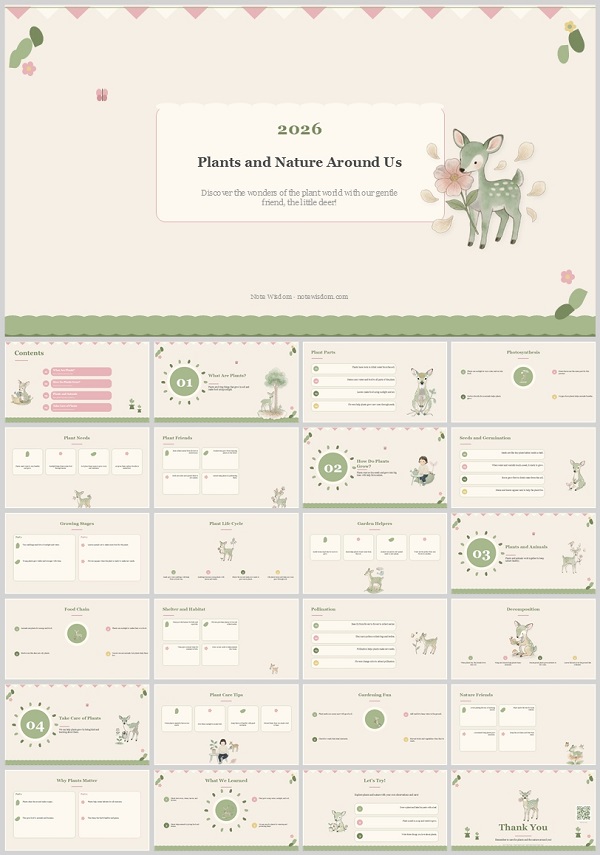
This pastel-themed presentation template uses a charming watercolor deer and botanical illustrations to teach young children about plant biology and ecology. It offers a structured, engaging slide-by-slide plan to help educators discuss photosynthesis, li
- Download this PPT
- Commercial use (1 project)
- Present publicly
2. Design Concept
Core design philosophy: "Gentle Botanical Discovery" – Fostering a love for nature through soft, inviting visuals and a friendly guide (the little deer), making scientific concepts accessible and magical for young learners.
-
1. Color System:
-
Primary: Creamy Beige (#F9F6F0) for backgrounds to create a warm, paper-like feel.
-
Secondary: Sage Green (#8F9A7C) and Muted Pink (#E8B4B8) for headings, borders, and accents.
-
Tertiary: Dark Olive (#4A4A3A) for body text to ensure high readability against the light background.
-
-
2. Visual Elements: Watercolor illustrations of a gentle deer, botanical elements (leaves, flowers, acorns, mushrooms), dotted connecting lines, rounded rectangular content cards, and soft wavy borders at the top and bottom.
-
3. Layout & Typography:
-
Layout: Clean, grid-based layouts with generous negative space. Centered headings with left-aligned or grid-aligned content blocks.
-
Typography: Elegant serif fonts (e.g., Playfair Display) for titles to evoke a storybook feel; clean, rounded sans-serif fonts (e.g., Lato, Open Sans) for body text for readability.
-
-
4. Design Goal: To create a calming, engaging educational experience that introduces young children to botany and ecology, encouraging curiosity and environmental stewardship.
-
Conclusion: A beautifully illustrated, nature-inspired presentation template perfect for early childhood education, combining scientific basics with a whimsical, soothing aesthetic.
3. Slide-by-Slide Outline
Slide 1: Title Slide
-
Title: Plants and Nature Around Us
-
Key Content: Main title, subtitle ("Discover the wonders of the plant world with our gentle friend, the little deer!"), and presenter/organization name.
-
Layout Suggestion: Center-aligned text inside a soft rounded box. Decorative wavy border at the top and bottom.
-
Image/Icon Suggestion: A large watercolor illustration of the little deer holding a flower on the right side, with scattered leaves and blossoms.
Slide 2: Contents / Agenda
-
Title: Our Learning Journey
-
Key Content: List of four main sections (01 What Are Plants?, 02 How Do Plants Grow?, 03 Plants and Animals, 04 Take Care of Plants).
-
Layout Suggestion: Vertical list on the left with pink rounded badges for each number. A small deer illustration at the bottom left.
-
Image/Icon Suggestion: Small watercolor botanical icons (a leaf, a sprout, a flower, a watering can) next to each section.
Slide 3: Section 01 Divider
-
Title: 01 What Are Plants?
-
Key Content: Transition slide introducing the basics of plant life.
-
Layout Suggestion: Large central circular badge with "01" inside. Title below with a dotted underline.
-
Image/Icon Suggestion: A cute, close-up watercolor illustration of the deer sitting near a small tree.
Slide 4: What Are Plants?
-
Title: What Are Plants?
-
Key Content: Simple definition of plants, distinguishing them from animals (e.g., they make their own food, they don't move around).
-
Layout Suggestion: Text on the left, a large illustration card on the right.
-
Image/Icon Suggestion: Watercolor scene of a thriving garden with various plants.
Slide 5: Plant Parts
-
Title: Plant Parts
-
Key Content: Introduction to roots, stems, leaves, and flowers.
-
Layout Suggestion: Three horizontal cards with rounded corners. Each card has an icon, a subheading, and a short description.
-
Image/Icon Suggestion: Watercolor icons of roots, a stem with leaves, and a blooming flower.
Slide 6: Photosynthesis
-
Title: Photosynthesis
-
Key Content: How plants make their own food using sunlight, water, and air.
-
Layout Suggestion: A central illustration surrounded by four text boxes pointing to the center.
-
Image/Icon Suggestion: A central watercolor scene of a plant absorbing sunlight, surrounded by small icons of a sun, a water drop, and a cloud.
Slide 7: Section 02 Divider
-
Title: 02 How Do Plants Grow?
-
Key Content: Transition slide introducing the life cycle of plants.
-
Layout Suggestion: Large central circular badge with "02" inside.
-
Image/Icon Suggestion: A small watercolor illustration of a seed sprouting.
Slide 8: Plant Needs
-
Title: Plant Needs
-
Key Content: The essential elements plants need to survive (sunlight, water, soil, air).
-
Layout Suggestion: Four vertical columns, each with a small illustration and a caption.
-
Image/Icon Suggestion: Watercolor icons of a sun, a watering can, soil, and wind.
Slide 9: Plant Friends
-
Title: Plant Friends
-
Key Content: How living things like bees, butterflies, and worms help plants.
-
Layout Suggestion: A grid of four small illustration cards with captions.
-
Image/Icon Suggestion: Watercolor bee, butterfly, worm, and ladybug.
Slide 10: Seeds and Germination
-
Title: Seeds and Germination
-
Key Content: The process of a seed waking up and starting to grow.
-
Layout Suggestion: A horizontal timeline with three steps (Seed, Water, Sprout).
-
Image/Icon Suggestion: Watercolor sequence showing a seed underground, then watered, then sprouting.
Slide 11: Growing Stages / Plant Life Cycle
-
Title: Plant Life Cycle
-
Key Content: From seed to sprout, to adult plant, to flower, and back to seed.
-
Layout Suggestion: A circular diagram with arrows showing the cycle.
-
Image/Icon Suggestion: Watercolor illustrations of each stage of the plant life cycle.
Slide 12: Section 03 Divider
-
Title: 03 Plants and Animals
-
Key Content: Transition to the relationship between plants and animals.
-
Layout Suggestion: Large central circular badge with "03" inside.
-
Image/Icon Suggestion: A watercolor deer eating leaves from a bush.
Slide 13: Food Chain & Shelter
-
Title: Food Chain and Shelter
-
Key Content: How animals rely on plants for food and a place to live.
-
Layout Suggestion: Split screen. Left side has text bullets; right side has a large illustration card.
-
Image/Icon Suggestion: Watercolor bird nesting in a tree, and a rabbit eating a carrot.
Slide 14: Pollination and Decomposition
-
Title: Pollination and Decomposition
-
Key Content: How bees help flowers make seeds, and how fallen leaves feed the soil.
-
Layout Suggestion: Two distinct blocks: "Pollination" and "Decomposition".
-
Image/Icon Suggestion: Watercolor bee covered in pollen, and a leaf turning into soil.
Slide 15: Section 04 Divider
-
Title: 04 Take Care of Plants
-
Key Content: Transition to environmental stewardship and conservation.
-
Layout Suggestion: Large central circular badge with "04" inside.
-
Image/Icon Suggestion: A watercolor deer watering a small plant.
Slide 16: Plant Care Tips & Gardening Fun
-
Title: Plant Care Tips
-
Key Content: Simple actions kids can take (water regularly, give sunlight, don't step on plants).
-
Layout Suggestion: A grid of four tips with small icons.
-
Image/Icon Suggestion: Watercolor watering can, sun, hands planting a seed, and a "no stepping" sign.
Slide 17: What We Learned
-
Title: What We Learned
-
Key Content: Summary of the three main takeaways (Plants are alive, Plants need our help, Plants help us).
-
Layout Suggestion: Three circular badges in the center, with text radiating outward.
-
Image/Icon Suggestion: Small watercolor icons of a leaf, a heart, and the Earth.
Slide 18: Thank You
-
Title: Thank You!
-
Key Content: Closing message, thank you, and contact/QR code.
-
Layout Suggestion: Centered text with a large illustration.
-
Image/Icon Suggestion: The little deer waving goodbye, surrounded by a wreath of leaves and flowers.
4. Speaker Notes
-
Slide 1: "Welcome, everyone! Today, we are going to explore the wonderful world of plants. Our gentle little deer friend is here to guide us. Are you ready to discover the magic of nature?"
-
Slide 2: "Let's look at our map for today. We will learn what plants are, how they grow, how they help animals, and most importantly, how we can take care of them."
-
Slide 3: "Let's start with our first big question: What exactly is a plant? It might seem simple, but plants are actually amazing living things!"
-
Slide 4: "Plants are different from us. They don't walk or talk, but they do eat and grow. They make their own food using sunlight, which is a superpower called photosynthesis!"
-
Slide 5: "Just like we have arms and legs, plants have parts. They have roots to drink water, stems to stand tall, and leaves to catch the sun."
-
Slide 6: "Let's talk about photosynthesis. This is how a plant turns sunlight, water, and air into food. It's like magic, but it's science!"
-
Slide 7: "Now, let's move on to our second section. How do these amazing plants grow from a tiny seed into a big tree?"
-
Slide 8: "Plants need a few things to grow. They need sunlight, water, healthy soil, and fresh air. Just like we need food and water!"
-
Slide 9: "Plants don't grow alone. They have friends! Bees, butterflies, and even worms help plants stay healthy and grow strong."
-
Slide 10: "It all starts with a seed. When a seed gets water and warmth, it wakes up and starts to grow. This is called germination."
-
Slide 11: "Let's look at the whole life cycle. A seed grows into a sprout, then a big plant, then it makes a flower, and the flower makes new seeds!"
-
Slide 12: "Now, let's see how plants and animals work together. They are very important to each other."
-
Slide 13: "Animals need plants for food and for a place to live. Birds build nests in trees, and rabbits eat plants. It's a big, connected family."
-
Slide 14: "Bees help flowers by moving pollen around, which helps make new seeds. And when leaves fall, they decompose and feed the soil. Nothing is wasted in nature!"
-
Slide 15: "Finally, it's our turn. How can we help our green friends? It's time to learn how to take care of plants."
-
Slide 16: "Taking care of plants is easy! We can water them, make sure they get sunlight, and be gentle around them. You can even plant your own seed!"
-
Slide 17: "So, what did we learn today? We learned that plants are living things, they need our help, and they help us in return. We are all connected!"
-
Slide 18: "Thank you for joining me on this nature adventure! Remember to say hello to the plants around you. Goodbye, friends!"
Article + Bundle Download