






 Note Wisdom
Dinosaur World Adventure: Meet the Giants of the Past and Discover How They Lived
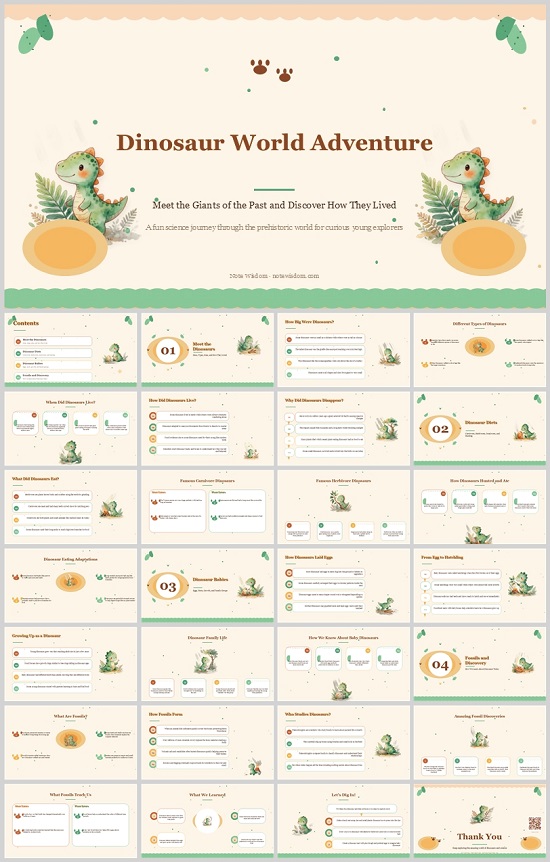
This engaging, pastel-themed presentation template uses adorable watercolor dinosaur illustrations to teach young children about prehistoric life. It offers a structured, easy-to-follow slide-by-slide plan to help educators discuss dinosaur types, diets,
- Download this PPT
- Commercial use (1 project)
- Present publicly
1. PPT Title
Dinosaur World Adventure: Meet the Giants of the Past and Discover How They Lived
2. Design Concept
Core design philosophy: "Prehistoric Playful Discovery" – Using soft, earthy aesthetics and friendly dinosaur mascots to make paleontology accessible, exciting, and non-threatening for young learners, sparking curiosity about natural history.
-
1. Color System:
-
Primary: Warm Cream (#FDF8F0) for backgrounds to create a soft, paper-like canvas.
-
Secondary: Sage Green (#A3B18A) and Muted Olive (#6B705C) for headings, borders, and accents.
-
Tertiary: Warm Orange/Yellow (#F4A261) and Soft Brown (#6B4F3A) for highlights, titles, and illustrations.
-
-
2. Visual Elements: Watercolor-style dinosaur illustrations (green T-Rex, Brachiosaurus), scattered leaves, fossil imprints, dinosaur footprints, dotted connecting lines, circular numbered badges (01, 02, 03, 04), and clean rounded rectangular content cards.
-
3. Layout & Typography:
-
Layout: Symmetrical title slide with center-aligned text. Clean, grid-based, airy content slides with generous white space. Left-aligned text blocks paired with corresponding illustrations.
-
Typography: Elegant serif fonts (e.g., Playfair Display) for titles to evoke a classic storybook feel; clean, rounded sans-serif fonts (e.g., Nunito, Quicksand) for body text to ensure readability for early readers.
-
-
4. Design Goal: To provide a structured, visually soothing educational tool that introduces young children to prehistoric life, dinosaur classification, and basic scientific concepts like fossils.
-
Conclusion: A beautifully designed, dinosaur-themed presentation template that perfectly balances scientific facts with a whimsical, child-friendly aesthetic, making it an ideal choice for early childhood science education.
3. Slide-by-Slide Outline
Slide 1: Title Slide
-
Title: Dinosaur World Adventure
-
Key Content: Main title, subtitle ("Meet the Giants of the Past and Discover How They Lived"), and a short descriptive tagline.
-
Layout Suggestion: Center-aligned text. Decorative wavy borders at the top and bottom.
-
Image/Icon Suggestion: Two cute watercolor dinosaurs (a T-Rex and a Brachiosaurus) on either side of the title, surrounded by prehistoric leaves and footprints.
Slide 2: Contents / Agenda
-
Title: Our Prehistoric Journey
-
Key Content: List of four main sections (01 Meet the Dinosaurs, 02 Dinosaur Diets, 03 Dinosaur Babies, 04 Fossils and Discovery).
-
Layout Suggestion: Vertical list on the left with earthy green rounded badges for each number. A small dinosaur illustration at the bottom right.
-
Image/Icon Suggestion: Small watercolor icons (a dinosaur, a leaf, an egg, a fossil) next to each section.
Slide 3: Section 01 Divider
-
Title: 01 Meet the Dinosaurs
-
Key Content: Transition slide introducing the basics of dinosaurs.
-
Layout Suggestion: Large central circular badge with "01" inside. Title below with a dotted underline.
-
Image/Icon Suggestion: A cute, close-up watercolor illustration of the T-Rex.
Slide 4: How Big Were Dinosaurs?
-
Title: How Big Were Dinosaurs?
-
Key Content: Comparing dinosaur sizes to familiar objects (e.g., as tall as a house, as small as a chicken).
-
Layout Suggestion: Three horizontal cards with rounded corners. Each card has an icon, a subheading, and two lines of text.
-
Image/Icon Suggestion: Watercolor icons of a tall building, a school bus, and a chicken.
Slide 5: Different Types of Dinosaurs
-
Title: Different Types of Dinosaurs
-
Key Content: Introduction to different groups (Theropods, Sauropods, Ceratopsians).
-
Layout Suggestion: A grid of four small illustration cards with captions.
-
Image/Icon Suggestion: Watercolor T-Rex, Brachiosaurus, Triceratops, and Stegosaurus.
Slide 6: When Did Dinosaurs Live?
-
Title: When Did Dinosaurs Live?
-
Key Content: The Mesozoic Era (Triassic, Jurassic, Cretaceous periods).
-
Layout Suggestion: A horizontal timeline with three steps.
-
Image/Icon Suggestion: Watercolor icons representing the three periods with different landscapes.
Slide 7: How Did Dinosaurs Live?
-
Title: How Did Dinosaurs Live?
-
Key Content: Habitats, eating, moving, and socializing.
-
Layout Suggestion: Split screen. Left side has text bullets; right side has a large illustration card.
-
Image/Icon Suggestion: Watercolor scene of dinosaurs in a lush prehistoric forest.
Slide 8: Why Did Dinosaurs Disappear?
-
Title: Why Did Dinosaurs Disappear?
-
Key Content: The asteroid theory and the impact on the Earth.
-
Layout Suggestion: Three horizontal cards with rounded corners.
-
Image/Icon Suggestion: Watercolor asteroid, volcano, and a sad dinosaur.
Slide 9: Section 02 Divider
-
Title: 02 Dinosaur Diets
-
Key Content: Transition slide introducing what dinosaurs ate.
-
Layout Suggestion: Large central circular badge with "02" inside.
-
Image/Icon Suggestion: A watercolor dinosaur eating a leaf.
Slide 10: What Did Dinosaurs Eat?
-
Title: What Did Dinosaurs Eat?
-
Key Content: Carnivores (meat-eaters), Herbivores (plant-eaters), Omnivores (both).
-
Layout Suggestion: Three horizontal cards with rounded corners.
-
Image/Icon Suggestion: Watercolor icons of meat, a leaf, and a mix of both.
Slide 11: Famous Carnivore Dinosaurs
-
Title: Famous Carnivore Dinosaurs
-
Key Content: T-Rex, Velociraptor, Spinosaurus.
-
Layout Suggestion: A grid of four small illustration cards with captions.
-
Image/Icon Suggestion: Watercolor T-Rex, Velociraptor, Spinosaurus, and Allosaurus.
Slide 12: Famous Herbivore Dinosaurs
-
Title: Famous Herbivore Dinosaurs
-
Key Content: Triceratops, Stegosaurus, Brachiosaurus.
-
Layout Suggestion: Split screen. Left side has text bullets; right side has a large illustration card.
-
Image/Icon Suggestion: Watercolor Triceratops, Stegosaurus, and Brachiosaurus eating plants.
Slide 13: How Dinosaurs Hunted and Ate
-
Title: How Dinosaurs Hunted and Ate
-
Key Content: Hunting strategies, teeth, and claws.
-
Layout Suggestion: Split screen. Left side has text bullets; right side has a large illustration card.
-
Image/Icon Suggestion: Watercolor T-Rex chasing a smaller dinosaur.
Slide 14: Dinosaur Eating Adaptations
-
Title: Dinosaur Eating Adaptations
-
Key Content: Sharp teeth vs. flat teeth, long necks for reaching leaves.
-
Layout Suggestion: Three horizontal cards with rounded corners.
-
Image/Icon Suggestion: Watercolor close-ups of sharp teeth and a long neck.
Slide 15: Section 03 Divider
-
Title: 03 Dinosaur Babies
-
Key Content: Transition slide introducing dinosaur reproduction.
-
Layout Suggestion: Large central circular badge with "03" inside.
-
Image/Icon Suggestion: A watercolor dinosaur egg.
Slide 16: How Dinosaurs Laid Eggs
-
Title: How Dinosaurs Laid Eggs
-
Key Content: The structure of nests and the number of eggs.
-
Layout Suggestion: Split screen. Left side has text bullets; right side has a large illustration card.
-
Image/Icon Suggestion: Watercolor dinosaur nest with eggs.
Slide 17: From Egg to Hatching
-
Title: From Egg to Hatching
-
Key Content: The hatching process and what baby dinosaurs look like.
-
Layout Suggestion: A horizontal timeline with three steps.
-
Image/Icon Suggestion: Watercolor sequence of an egg cracking and a baby dinosaur emerging.
Slide 18: Growing Up as a Dinosaur
-
Title: Growing Up as a Dinosaur
-
Key Content: How baby dinosaurs grew, what they ate, and how they were protected.
-
Layout Suggestion: Split screen. Left side has text bullets; right side has a large illustration card.
-
Image/Icon Suggestion: Watercolor baby dinosaur next to an adult dinosaur.
Slide 19: Dinosaur Family Life
-
Title: Dinosaur Family Life
-
Key Content: Did dinosaurs live in families? (Some did, some didn't).
-
Layout Suggestion: A grid of four small illustration cards with captions.
-
Image/Icon Suggestion: Watercolor dinosaur families together, and some solitary dinosaurs.
Slide 20: How We Know About Baby Dinosaurs
-
Title: How We Know About Baby Dinosaurs
-
Key Content: Fossilized eggs and embryos.
-
Layout Suggestion: Three horizontal cards with rounded corners.
-
Image/Icon Suggestion: Watercolor fossilized egg and a paleontologist studying it.
Slide 21: Section 04 Divider
-
Title: 04 Fossils and Discovery
-
Key Content: Transition slide introducing paleontology.
-
Layout Suggestion: Large central circular badge with "04" inside.
-
Image/Icon Suggestion: A watercolor fossil imprint or a magnifying glass.
Slide 22: What Are Fossils?
-
Title: What Are Fossils?
-
Key Content: Definition of fossils and how they are formed.
-
Layout Suggestion: Split screen. Left side has text bullets; right side has a large illustration card.
-
Image/Icon Suggestion: Watercolor fossilized bones and a dinosaur skeleton.
Slide 23: How Fossils Form
-
Title: How Fossils Form
-
Key Content: The process of fossilization (burial, minerals, discovery).
-
Layout Suggestion: A horizontal timeline with three steps.
-
Image/Icon Suggestion: Watercolor sequence of a dinosaur sinking into mud and turning into a fossil.
Slide 24: Who Studies Dinosaurs?
-
Title: Who Studies Dinosaurs?
-
Key Content: Paleontologists and their tools.
-
Layout Suggestion: Split screen. Left side has text bullets; right side has a large illustration card.
-
Image/Icon Suggestion: Watercolor paleontologist digging with a brush and shovel.
Slide 25: Amazing Fossil Discoveries
-
Title: Amazing Fossil Discoveries
-
Key Content: Famous fossil finds around the world.
-
Layout Suggestion: A grid of four small illustration cards with captions.
-
Image/Icon Suggestion: Watercolor map, a large skeleton, and a paleontologist's tools.
Slide 26: What We Learned / Let's Dig!
-
Title: What We Learned / Let's Dig!
-
Key Content: Summary of the presentation and an interactive activity.
-
Layout Suggestion: Two distinct blocks: "What We Learned" (three circular badges) and "Let's Dig!" (checklist).
-
Image/Icon Suggestion: Small watercolor icons of a dinosaur, an egg, a leaf, and a fossil.
Slide 27: Thank You
-
Title: Thank You!
-
Key Content: Closing message, thank you to the audience, and contact/QR code.
-
Layout Suggestion: Centered text with a large illustration.
-
Image/Icon Suggestion: The T-Rex waving goodbye, surrounded by leaves and footprints.
4. Speaker Notes
-
Slide 1: "Welcome, young explorers! Today, we are going on a magical adventure back in time to meet the most amazing creatures that ever lived: the dinosaurs! Let's get ready to stomp and roar!"
-
Slide 2: "Here is our plan for today. We will learn about different dinosaurs, what they ate, how they had babies, and how we know about them today through fossils."
-
Slide 3: "Let's start with our first section: Meet the Dinosaurs. There were so many different kinds, and they lived a very long time ago."
-
Slide 4: "Dinosaurs came in all shapes and sizes. Some were as tall as a house, and some were only as big as a chicken! Can you imagine a chicken-sized dinosaur?"
-
Slide 5: "We can group dinosaurs by their features. Some walked on two legs, some on four. Some had horns, and some had plates on their backs."
-
Slide 6: "Dinosaurs lived during a time called the Mesozoic Era. It had three parts: the Triassic, Jurassic, and Cretaceous periods. That's a lot of big words!"
-
Slide 7: "They lived in forests, near lakes, and on plains. They hunted, ate, and raised their babies, just like animals do today."
-
Slide 8: "Sadly, about 66 million years ago, a giant asteroid hit the Earth. This changed the climate so much that dinosaurs couldn't survive."
-
Slide 9: "Now, let's move to our second section: Dinosaur Diets. What did these giants eat?"
-
Slide 10: "Some dinosaurs were carnivores, which means they ate meat. Others were herbivores, which means they ate plants. Some were omnivores and ate both!"
-
Slide 11: "The T-Rex was a famous carnivore. It had sharp teeth for tearing meat and strong legs for chasing prey."
-
Slide 12: "The Triceratops was a herbivore. It used its beak to bite off plants, and its horns to protect itself from predators."
-
Slide 13: "Carnivores had to hunt to survive. They used their sharp claws, teeth, and speed to catch their food."
-
Slide 14: "Dinosaurs adapted to their diets. Herbivores had flat teeth for grinding plants, while carnivores had sharp teeth for slicing meat."
-
Slide 15: "Our third section is all about Dinosaur Babies. Even the biggest dinosaurs started out small!"
-
Slide 16: "Dinosaurs laid eggs. Some built nests in the ground, while others buried their eggs to keep them safe."
-
Slide 17: "When the baby dinosaurs were ready, they hatched from their eggs. They were called hatchlings."
-
Slide 18: "Some baby dinosaurs stayed with their parents for protection, while others were on their own from the start."
-
Slide 19: "Some dinosaurs lived in family groups, called herds. They traveled together and helped protect each other."
-
Slide 20: "How do we know about baby dinosaurs? Paleontologists have found fossilized eggs and even baby dinosaur bones!"
-
Slide 21: "Finally, let's talk about Fossils and Discovery. This is how we learn about dinosaurs today."
-
Slide 22: "Fossils are the remains of plants and animals that lived a long time ago. They are found in rocks."
-
Slide 23: "When a dinosaur died, it was buried by mud and sand. Over millions of years, the bones turned into stone."
-
Slide 24: "Paleontologists are scientists who study fossils. They dig carefully to find bones and put them together like a puzzle."
-
Slide 25: "Some amazing discoveries include huge skeletons and fossilized skin. Every new fossil teaches us something new."
-
Slide 26: "So, what did we learn today? We learned about different dinosaurs, their diets, their babies, and how we study them. Now, let's try a fun activity! Can you roar like a T-Rex?"
-
Slide 27: "Thank you for joining me on this prehistoric adventure! Remember to stay curious and keep exploring the world around you. Goodbye, explorers!"
Article + Bundle Download