






 Note Wisdom
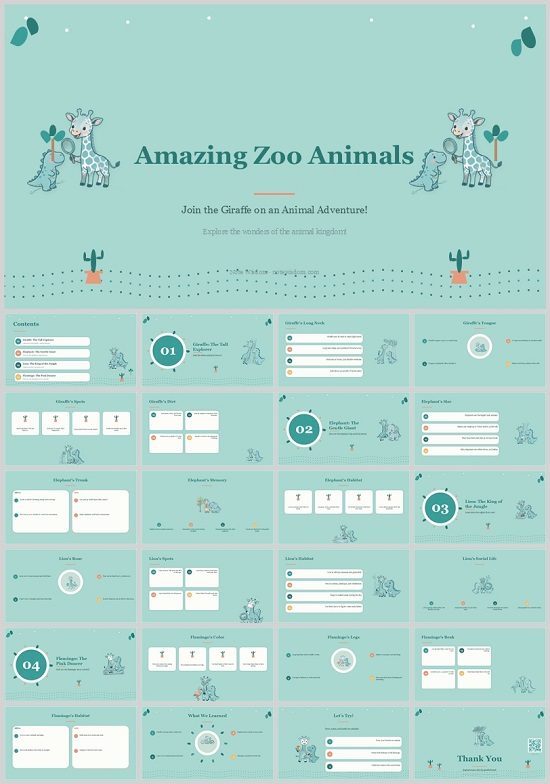
Amazing Zoo Animals: Join the Giraffe on an Animal Adventure!
This vibrant, teal-themed presentation template uses adorable watercolor zoo animals to teach young children about wildlife. It offers a structured, engaging slide-by-slide plan to help educators discuss animal traits, habitats, and diets, making early sc
- Download this PPT
- Commercial use (1 project)
- Present publicly
1. PPT Title
Amazing Zoo Animals: Join the Giraffe on an Animal Adventure!
2. Design Concept
Core design philosophy: "Playful Wildlife Discovery" – Engaging young minds with friendly, colorful animal characters to foster curiosity and a love for the natural world through a gentle, educational narrative.
-
1. Color System:
-
Primary: Soft Teal/Mint Green (#A3D8D8) for the main background to create a calm, refreshing atmosphere.
-
Secondary: Cloud White (#FFFFFF) for content boxes, and Coral/Peach (#F2A68D) and Soft Yellow (#F4D35E) for accents and highlights.
-
Tertiary: Dark Slate Gray (#2F4F4F) for body text to ensure high readability against the light background.
-
-
2. Visual Elements: Watercolor-style animal cliparts (giraffe, crocodile, elephant, lion, flamingo), dotted line paths, subtle leaf motifs, small cacti, rounded rectangular content cards, and circular numbered badges (01, 02, 03, 04).
-
3. Layout & Typography:
-
Layout: Clean, grid-based layouts with generous negative space. Symmetrical title slides with centered headings and structured left-aligned or grid-aligned content blocks.
-
Typography: Elegant serif fonts (e.g., Playfair Display) for titles to evoke a storybook feel; clean, rounded sans-serif fonts (e.g., Quicksand, Nunito) for body text to ensure readability for early readers.
-
-
4. Design Goal: To create a fun, accessible, and visually engaging educational tool that introduces young children to zoology, animal habitats, and unique physical traits.
-
Conclusion: A charming, visually consistent presentation template that perfectly balances scientific facts with a playful, child-friendly aesthetic, making it an ideal choice for early childhood nature and animal education.
3. Slide-by-Slide Outline
Slide 1: Title Slide
-
Title: Amazing Zoo Animals
-
Key Content: Main title, subtitle ("Join the Giraffe on an Animal Adventure!"), and a short descriptive tagline.
-
Layout Suggestion: Center-aligned text. Decorative dotted lines and small cacti at the bottom.
-
Image/Icon Suggestion: A cute watercolor giraffe and crocodile on the left, and a giraffe holding a magnifying glass on the right.
Slide 2: Contents / Agenda
-
Title: Our Animal Adventure
-
Key Content: List of four main sections (01 Giraffe: The Tall Explorer, 02 Elephant: The Gentle Giant, 03 Lion: King of the Jungle, 04 Flamingo: The Pink Dancer).
-
Layout Suggestion: Vertical list on the left with teal rounded badges for each number. A small giraffe illustration at the bottom right.
-
Image/Icon Suggestion: Small watercolor icons (a giraffe, an elephant, a lion, a flamingo) next to each section.
Slide 3: Section 01 Divider
-
Title: 01 Giraffe: The Tall Explorer
-
Key Content: Transition slide introducing the giraffe.
-
Layout Suggestion: Large central circular badge with "01" inside. Title below with a dotted underline.
-
Image/Icon Suggestion: A cute, close-up watercolor illustration of the giraffe.
Slide 4: Giraffe's Long Neck
-
Title: Giraffe's Long Neck
-
Key Content: Why the giraffe has a long neck (to reach leaves high up in trees).
-
Layout Suggestion: Text on the left, a large illustration card on the right.
-
Image/Icon Suggestion: Watercolor giraffe eating leaves from the top of a tall tree.
Slide 5: Giraffe's Tongue
-
Title: Giraffe's Tongue
-
Key Content: Fun facts about the giraffe's tongue (it's purple/blue, about 20 inches long, and tough).
-
Layout Suggestion: Three horizontal cards with rounded corners. Each card has an icon, a subheading, and a short description.
-
Image/Icon Suggestion: Watercolor giraffe sticking out its tongue to grab a leaf.
Slide 6: Giraffe's Spots
-
Title: Giraffe's Spots
-
Key Content: Every giraffe has a unique spot pattern, used for camouflage.
-
Layout Suggestion: A grid of four small illustration cards with captions.
-
Image/Icon Suggestion: Watercolor close-ups of different giraffe spot patterns.
Slide 7: Giraffe's Diet
-
Title: Giraffe's Diet
-
Key Content: What giraffes eat (herbivores, acacia leaves, twigs).
-
Layout Suggestion: Split screen. Left side has text bullets; right side has a large illustration card.
-
Image/Icon Suggestion: Watercolor giraffe eating from an acacia tree.
Slide 8: Section 02 Divider
-
Title: 02 Elephant: The Gentle Giant
-
Key Content: Transition slide introducing the elephant.
-
Layout Suggestion: Large central circular badge with "02" inside.
-
Image/Icon Suggestion: A watercolor elephant spraying water.
Slide 9: Elephant's Size
-
Title: Elephant's Size
-
Key Content: The elephant is the largest land animal. Facts about its weight and height.
-
Layout Suggestion: Three horizontal cards with rounded corners.
-
Image/Icon Suggestion: Watercolor elephant standing next to a tree to show scale.
Slide 10: Elephant's Trunk
-
Title: Elephant's Trunk
-
Key Content: The trunk is a multi-purpose tool (smelling, drinking, grabbing, trumpeting).
-
Layout Suggestion: Split screen. Left side has text bullets; right side has a large illustration card.
-
Image/Icon Suggestion: Watercolor elephant using its trunk to pick up a peanut or spray water.
Slide 11: Elephant's Memory
-
Title: Elephant's Memory
-
Key Content: Elephants have excellent memories, remembering friends and places for years.
-
Layout Suggestion: A grid of four small illustration cards with captions.
-
Image/Icon Suggestion: Watercolor elephant remembering a path or a friend.
Slide 12: Elephant's Habitat
-
Title: Elephant's Habitat
-
Key Content: Where elephants live (savannas, forests, grasslands).
-
Layout Suggestion: Split screen. Left side has text bullets; right side has a large illustration card.
-
Image/Icon Suggestion: Watercolor elephant in a savanna landscape with a sunset.
Slide 13: Section 03 Divider
-
Title: 03 Lion: King of the Jungle
-
Key Content: Transition slide introducing the lion.
-
Layout Suggestion: Large central circular badge with "03" inside.
-
Image/Icon Suggestion: A watercolor lion with a majestic mane.
Slide 14: Lion's Roar
-
Title: Lion's Roar
-
Key Content: Why lions roar (communication, marking territory).
-
Layout Suggestion: Three horizontal cards with rounded corners.
-
Image/Icon Suggestion: Watercolor lion roaring with sound wave lines.
Slide 15: Lion's Spots
-
Title: Lion's Spots
-
Key Content: Lion cubs have spots for camouflage, which fade as they grow.
-
Layout Suggestion: Split screen. Left side has text bullets; right side has a large illustration card.
-
Image/Icon Suggestion: Watercolor lion cub with faint spots.
Slide 16: Lion's Habitat
-
Title: Lion's Habitat
-
Key Content: Where lions live (grasslands, savannas).
-
Layout Suggestion: A grid of four small illustration cards with captions.
-
Image/Icon Suggestion: Watercolor lion resting under a tree in the savanna.
Slide 17: Lion's Social Life
-
Title: Lion's Social Life
-
Key Content: Lions live in family groups called prides.
-
Layout Suggestion: Split screen. Left side has text bullets; right side has a large illustration card.
-
Image/Icon Suggestion: Watercolor lion family (male, female, cubs) together.
Slide 18: Section 04 Divider
-
Title: 04 Flamingo: The Pink Dancer
-
Key Content: Transition slide introducing the flamingo.
-
Layout Suggestion: Large central circular badge with "04" inside.
-
Image/Icon Suggestion: A watercolor flamingo standing on one leg.
Slide 19: Flamingo's Color
-
Title: Flamingo's Color
-
Key Content: Why flamingos are pink (they eat shrimp and algae).
-
Layout Suggestion: Three horizontal cards with rounded corners.
-
Image/Icon Suggestion: Watercolor flamingo eating shrimp.
Slide 20: Flamingo's Legs
-
Title: Flamingo's Legs
-
Key Content: Long legs for wading in water, and they often stand on one leg to conserve heat.
-
Layout Suggestion: Split screen. Left side has text bullets; right side has a large illustration card.
-
Image/Icon Suggestion: Watercolor flamingo standing on one leg in water.
Slide 21: Flamingo's Beak
-
Title: Flamingo's Beak
-
Key Content: Curved beak used upside down to filter food from the water.
-
Layout Suggestion: A grid of four small illustration cards with captions.
-
Image/Icon Suggestion: Watercolor flamingo with its beak in the water.
Slide 22: Flamingo's Habitat
-
Title: Flamingo's Habitat
-
Key Content: Where flamingos live (lagoons, lakes, mudflats).
-
Layout Suggestion: Split screen. Left side has text bullets; right side has a large illustration card.
-
Image/Icon Suggestion: Watercolor flamingo in a lagoon with other flamingos.
Slide 23: What We Learned
-
Title: What We Learned
-
Key Content: Summary of the four animals and their unique traits.
-
Layout Suggestion: Three circular badges in the center, with text radiating outward.
-
Image/Icon Suggestion: Small watercolor icons of a giraffe, elephant, lion, and flamingo.
Slide 24: Let's Try!
-
Title: Let's Try!
-
Key Content: A simple matching activity (e.g., match the animal to its special feature).
-
Layout Suggestion: Interactive layout with drag-and-drop or matching lines.
-
Image/Icon Suggestion: Watercolor animals on one side and their traits (long neck, trunk, roar, pink color) on the other.
Slide 25: Thank You
-
Title: Thank You!
-
Key Content: Closing message, thank you, and contact/QR code.
-
Layout Suggestion: Centered text with a large illustration.
-
Image/Icon Suggestion: The giraffe waving goodbye, surrounded by leaves and cacti.
4. Speaker Notes
-
Slide 1: "Welcome, everyone! Today, we are going on a wild adventure to the zoo! Look at our friendly giraffe guide. He is holding a magnifying glass because we are going to be animal detectives and learn amazing facts."
-
Slide 2: "Here is our map for today. We will meet four incredible animals: the tall giraffe, the gentle elephant, the mighty lion, and the beautiful flamingo."
-
Slide 3: "Let's start with our first animal. It's the tallest animal in the world. Can you guess who it is? Yes, it's the giraffe!"
-
Slide 4: "Why does a giraffe have such a long neck? It helps them reach the tastiest leaves at the very top of the trees, where no other animals can reach."
-
Slide 5: "Look at this! A giraffe's tongue is very special. It is dark purple or blue to protect it from the sun, and it is almost two feet long! That's as long as your arm!"
-
Slide 6: "Every giraffe has a different pattern of spots. Just like your fingerprints, no two giraffes have the exact same spots. Their spots help them hide in the trees."
-
Slide 7: "Giraffes are herbivores, which means they only eat plants. Their favorite food is the acacia tree. They use their long tongues to strip the leaves off the branches."
-
Slide 8: "Now, let's move on to our next animal. It's the biggest animal that walks on land. Can you stomp your feet like an elephant?"
-
Slide 9: "Elephants are huge! They can weigh as much as three cars. But even though they are big, they are very gentle giants."
-
Slide 10: "An elephant's trunk is amazing. It's like a nose, a hand, and a straw all in one! They use it to smell, to drink water, and to pick up food."
-
Slide 11: "Did you know elephants never forget? They have amazing memories. They can remember their friends and their favorite places to find water for many, many years."
-
Slide 12: "Elephants live in places called savannas and forests. They love to be near water so they can drink and take mud baths to stay cool."
-
Slide 13: "Our third animal is known as the King of the Jungle. Let's hear a big roar for the lion!"
-
Slide 14: "A lion's roar is very loud. It can be heard from five miles away! They roar to tell other lions, 'This is my home!'"
-
Slide 15: "Look at the baby lion, called a cub. When they are born, they have spots on their fur. These spots help them hide in the grass. As they grow up, the spots fade away."
-
Slide 16: "Lions live in the grasslands of Africa. They like to rest in the shade during the hot day and hunt at night."
-
Slide 17: "Lions are very social animals. They live in big family groups called prides. The lionesses do most of the hunting together."
-
Slide 18: "Our last animal is a beautiful bird that loves to dance. It's the flamingo!"
-
Slide 19: "Why are flamingos pink? It's because of what they eat! They eat tiny shrimp and algae that turn their feathers a beautiful pink color."
-
Slide 20: "Flamingos have very long legs. They like to wade in the water. Sometimes, they stand on just one leg to keep warm!"
-
Slide 21: "Their beaks are curved. They use them upside down in the water to filter out tiny food, just like a strainer."
-
Slide 22: "Flamingos live in lagoons and lakes. They love to gather in big groups called flamboyances."
-
Slide 23: "Wow, what an adventure! We learned about the giraffe's long neck, the elephant's trunk, the lion's roar, and the flamingo's pink color."
-
Slide 24: "Now it's your turn! Let's see if you can match the animal to its special feature. Can you point to the animal with the trunk? Great job!"
-
Slide 25: "Thank you for joining me on this animal adventure! Remember to be kind to all the amazing animals in the world. Goodbye, friends!"
Article + Bundle Download