One. Course Details
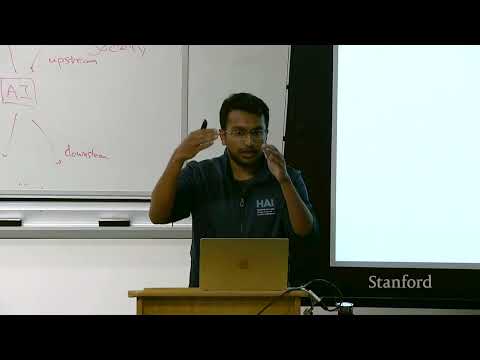
This is a special guest lecture of Stanford University's CME 296: Diffusion and Large Vision Models, hosted by Percy Liang and featuring Rishi Bommasani, a senior research scholar at Stanford and co-author of the landmark paper that coined the term "foundation models." Rishi earned his PhD from Stanford in 2024 and advises policymakers in both the U.S. and EU on AI regulation, with his current research focused on the intersection of artificial intelligence and economics.
The lecture moves beyond technical model development to explore the broader ecosystem that shapes AI's impact on society. It is structured into three core sections: the global AI supply chain (covering compute, data and distribution), the economic theory of general purpose technologies, and three competing scenarios for AI's long-term impact on economic growth. The central thesis is that technologists must understand both the technology itself and the organizational, political and economic forces that determine how it is deployed and who benefits from it.
Two. Key Learning Takeaways
The top seven AI companies now represent over one-third of the entire S&P 500 market capitalization, making AI the single most important economic force of the current decade.
The compute supply chain is extraordinarily concentrated, with three companies holding near-monopolies at critical layers: ASML (lithography), TSMC (chip manufacturing) and NVIDIA (GPU design).
Data acquisition is the most legally and economically complex part of the AI supply chain, with pricing varying by orders of magnitude depending on how the data is obtained.
AI satisfies all three formal criteria for a general purpose technology: pervasiveness across sectors, continuous improvement in capability and price, and the ability to spawn complementary innovations.
Traditional GDP is a poor measure of AI's economic impact because most AI services are heavily subsidized or free to users, creating massive unmeasured consumer surplus.
The productivity J-curve predicts that general purpose technologies initially show muted economic effects as organizations learn to adapt, followed by decades of accelerated growth.
Model distribution strategy is the single most important decision shaping downstream market structure, competition and innovation.
Three. Course Gold Quotes
"Most of us think about AI as what's inside the box—the algorithms, the models, the objective functions. But the real story of AI's impact is what's outside the box: the resources, the organizations, the policies and the people."
"AI isn't just a technology—it's a global supply chain that stretches from lithography machines in the Netherlands to data centers in Oregon to web crawlers on every corner of the internet."
"The compute supply chain is a story of monopolies. At every critical layer, there's exactly one company that everyone depends on. That's not an accident—that's how the technology evolved."
"Electricity itself didn't change the world. What changed the world were all the things we built on top of electricity: light bulbs, factories, home appliances, night shifts. The same will be true for AI."
"GDP measures payments, not value. If a technology is free or heavily subsidized, it can be transformative for billions of people and barely show up in the national accounts."
"The biggest mistake technologists make is assuming that better technology automatically leads to better outcomes. How you distribute the technology, who controls it, and who gets the benefits matter far more than the raw capability."
"Research is about betting on the future. But economics is about understanding who pays for the bets and who gets the winnings."
Four. Layered Learning Notes
Module 1: The Dual Lens of AI Economic Analysis
Rishi opens by arguing that technical understanding alone is insufficient to predict AI's real-world impact. We must analyze AI through two complementary lenses: the technology itself, and the ecosystem of organizations that develop, deploy and regulate it.
There are three fundamental questions that define the economics of AI:
-
How will AI as a general purpose technology affect the overall global economy?
-
Which specific companies and groups will capture the majority of the value created by AI?
-
How will AI transform individual jobs, wages and the future of work?
He presents early empirical evidence showing that since the release of ChatGPT in November 2022, there has been a sharp and sustained decline in hiring for entry-level software engineering positions. However, he also highlights a counterintuitive finding from call center studies: generative AI tools benefit junior workers the most, reducing the performance gap between new hires and experienced employees by nearly 30%.
Module 2: The Compute Supply Chain: A Story of Monopolies
The compute supply chain is the most concentrated and geopolitically sensitive part of the AI ecosystem. Rishi breaks down the three critical bottlenecks that control access to frontier AI computing:
-
ASML (Netherlands): Holds a global monopoly on extreme ultraviolet (EUV) lithography machines, the only technology capable of manufacturing the most advanced semiconductor chips. No EUV machine means no advanced GPUs.
-
TSMC (Taiwan): Manufactures over 90% of the world's advanced semiconductors, including all NVIDIA H100 and H200 GPUs used for frontier model training.
-
NVIDIA (United States): Controls approximately 80% of the global GPU market for AI training and inference, with its CUDA software ecosystem creating an almost unassailable moat.
This extreme concentration creates three major risks: supply chain fragility, geopolitical weaponization of technology, and massive value accrual to a tiny number of companies. Rishi notes that these three companies are now among the most valuable in their respective regions, with NVIDIA alone surpassing the entire market capitalization of the Chinese tech sector at one point in 2025.
Downstream from chip manufacturing, the cloud computing market is dominated by three players: Amazon Web Services, Microsoft Azure and Google Cloud. These three control nearly all large-scale model training capacity, though the inference market is becoming more fragmented with specialized startups emerging to serve specific use cases.
Module 3: The Data Supply Chain: Fragmentation and Legal Chaos
In stark contrast to the compute supply chain, the data supply chain is highly fragmented and rapidly evolving. Rishi categorizes data acquisition into six distinct channels, each with different economics, legal risks and accessibility:
-
Synthetic data: Generated internally by AI companies using existing models, with cost equal primarily to compute expenses.
-
User usage data: Collected as a byproduct of users interacting with products like ChatGPT, Gmail or Facebook, effectively free to the company under standard terms of service.
-
Public datasets: Curated datasets like The Pile or SQuAD that are freely available for research and commercial use.
-
Web crawled data: The single largest source of pre-training data, scraped from billions of public web pages.
-
Licensed data: Content purchased from third parties like news organizations, book publishers or Reddit.
-
Annotated data: Human-labeled data used for fine-tuning and alignment, priced based on human labor hours.
He presents data showing that since 2022, an increasing number of websites have implemented robots.txt restrictions specifically targeting AI crawlers, with OpenAI's crawler being the most frequently blocked. This growing "data wall" is creating asymmetries between large incumbents who already have massive data stockpiles and new entrants trying to build competitive models.
The legal status of web crawling for AI training remains one of the biggest unresolved questions in the AI ecosystem. Rishi highlights the 2025 Anthropic-Bartz settlement, which set a precedent of approximately $3,000 per copyrighted work, fundamentally changing the economics of data acquisition for future models.
Module 4: Model Distribution Strategy and Market Structure
Rishi identifies model distribution as the most underappreciated factor shaping the AI economy. He presents a spectrum of distribution strategies, from fully closed to fully open source:
-
Fully closed: Models are never released externally, only integrated into the company's own products.
-
API access: Users can query the model via an API but never gain access to the weights.
-
Weight release with restrictions: Model weights are released but subject to licensing terms that restrict commercial use or modification.
-
Fully open source: Weights, code and training data are released with no significant restrictions.
The choice of distribution strategy has three profound consequences:
-
Vertical integration: Closed models allow companies to capture more value downstream by building exclusive products on top of their models.
-
Pricing: Open models create competitive inference markets that drive prices down by 90% or more compared to closed API equivalents.
-
Application ecosystem: Open models enable use cases that require data privacy, on-premise deployment or custom fine-tuning that are impossible with closed APIs.
Rishi emphasizes that there is no inherently "better" distribution strategy—each represents a different tradeoff between control, reach and value capture.
Module 5: AI as a General Purpose Technology
The second half of the lecture shifts to long-term economic growth, starting with the question: is AI a general purpose technology (GPT)? Economists define GPTs by three criteria:
-
Pervasiveness: The technology is adopted across virtually all economic sectors.
-
Continuous improvement: The technology gets better and cheaper over time.
-
Complementary innovation: The technology spawns entirely new products, services and ways of organizing work.
Rishi argues that foundation models satisfy all three criteria. They are already being used in healthcare, finance, manufacturing, education and every other major sector. Model capabilities have improved exponentially while inference costs have fallen by over 99% since 2020. And most importantly, we are already seeing the early stages of complementary innovation, from AI coding assistants to entirely new job roles focused on verifying AI outputs.
A key prediction from GPT theory is the productivity J-curve: new general purpose technologies initially show little to no impact on aggregate productivity as organizations invest in learning and reorganization. After this initial trough, productivity growth accelerates dramatically for decades. Rishi suggests that we are currently in the early trough of the AI J-curve, which explains the disconnect between the enormous hype around AI and the relatively modest productivity gains observed in official statistics so far.
Module 6: The Limitations of GDP and Alternative Measures
A central theme of the lecture is that traditional Gross Domestic Product (GDP) is a deeply flawed metric for measuring AI's economic impact. GDP measures only monetary transactions, so technologies that are free or heavily subsidized create massive value that never appears in official statistics.
Rishi introduces GDP-B, an alternative metric developed by Stanford economists that measures consumer surplus—the total value consumers receive from a product beyond what they actually pay for it. A 2025 survey using this methodology found that the average frequent generative AI user would require $98 per month to stop using these tools, implying an annual consumer surplus of over $100 billion in the United States alone.
This means that AI is already creating enormous value for consumers, but most of that value is not being captured in traditional economic statistics. Rishi argues that we need new measurement frameworks to properly understand AI's true impact on society.
Module 7: Three Scenarios for AI's Long-Term Economic Impact
Rishi concludes by presenting three competing frameworks for thinking about AI's long-term effect on economic growth:
-
Sector-specific productivity boom: AI primarily transforms the software sector, making software development dramatically more productive. In this scenario, software prices fall sharply, but other sectors like healthcare and education become relatively more expensive due to Baumol's cost disease. Overall GDP growth increases modestly.
-
General labor augmentation: AI acts as a cheap, flexible form of labor that can perform a wide range of cognitive tasks across all sectors. In this scenario, GDP growth accelerates significantly as the effective labor supply expands dramatically. Rishi places the highest probability on this outcome.
-
Idea generation engine: AI's most important impact is accelerating the rate of scientific discovery and technological innovation itself. In this scenario, AI creates a positive feedback loop where better technology leads to faster scientific progress, which leads to even better technology. This would result in super-exponential economic growth, fundamentally changing the trajectory of human civilization.
He emphasizes that none of these outcomes are predetermined. Which scenario we get will depend not just on technical progress, but on the policy choices we make, the institutions we build, and how we choose to distribute the benefits of AI across society.
Wishing you a nuanced and holistic understanding of artificial intelligence as you continue your studies. May you always look beyond the code to see the people, organizations and systems that shape how technology impacts the world. May your technical skills be matched by equally strong critical thinking about the economic and societal consequences of the systems you build. Whether you go on to research, industry or policy, may you work to ensure that the benefits of AI are shared broadly and fairly across all of society. Good luck with the rest of the quarter and all your future endeavors!