One. Course Details
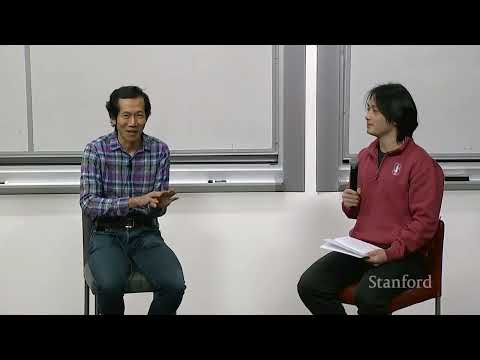
This is a special fireside chat session of Stanford University's CME 296: Diffusion and Large Vision Models, moderated by Ken and featuring guest speaker Percy Liang, a tenured professor of computer science at Stanford University. Percy earned his undergraduate and doctoral degrees from MIT, founded Stanford's iconic CS221 introductory AI course, and leads one of the most influential AI research groups in the world.
The session is structured into three core segments: career, life and research advice; Stanford classes and miscellaneous campus questions; and AI industry status and future outlook. Drawing on over 20 years of experience in AI research and education, Percy answered dozens of top-voted student questions, covering everything from beginner learning paths to career decisions, from academic research methodology to global AI trends, while sharing his unfiltered perspective on the technology's true nature and societal impact.
Two. Key Learning Takeaways
AI has evolved from a niche academic pursuit to a century-level general-purpose technology, comparable in transformative power to the invention of computing itself.
Academia retains irreplaceable unique value in the era of large models, particularly in long-term blue-sky research, independent ethical evaluation, and unbiased model assessment that industry cannot perform due to inherent conflicts of interest.
The only future-proof skill in the AI revolution is the ability to learn and adapt rapidly, as specific technical skills become obsolete at an accelerating pace.
Traditional entry-level software engineering roles are fundamentally evolving, shifting from writing boilerplate code to defining what to build and directing AI tools effectively.
The Turing test is no longer a meaningful benchmark for AI progress; a far better measure is the number of original scientific discoveries enabled by AI systems.
Research is about taking informed bets on the future, and the most impactful work addresses fundamental gaps rather than chasing incremental improvements on existing benchmarks.
The greatest untapped potential of AI lies in cross-disciplinary applications, not just building better consumer chatbots and assistants.
Three. Course Gold Quotes
"AI isn't a sentient robot walking through the door—it's infrastructure, already making millions of quiet decisions in the background every single day."
"Research is by definition barely working. If it already works perfectly, it's not research anymore."
"Your first job isn't a marriage—it's a few years of growth. Prioritize learning over everything else."
"The best research has both a grand vision of what needs to be fixed and a concrete first step you can take tomorrow."
"Everyone is racing to build another AI assistant, but we're just scratching the surface of what this technology can do for science, climate, and medicine."
"Skills get outdated, but the ability to peel back layers and understand how things work from first principles never will."
"AI didn't replace calculators—it made people who can use calculators far more powerful. The exact same thing will happen with software engineers."
Four. Layered Learning Notes
Module 1: AI Today—Public Perception and Ground Reality
Percy opened by discussing the seismic shift in AI's status over the past three years. What was once a specialized field confined to university labs and corporate research divisions has become a global cultural and economic force, with AI billboards lining Highway 101 and national governments rewriting their industrial policies around the technology.
He highlighted a critical cultural divide in public perception: Western audiences tend to view AI through the lens of science fiction, with fears of sentient robots and existential risk dominating the conversation. In contrast, many Asian countries have a far more optimistic view of AI as a productivity tool that can improve quality of life. Percy argued that both narratives miss the mark. The real impact of AI is already here, operating invisibly as digital infrastructure—powering recommendation systems, fraud detection, and backend business processes—rather than as humanoid agents.
When asked about the most overhyped and underhyped capabilities of current AI:
-
Most underhyped: The foundational power of next-token prediction. While post-training techniques like alignment and fine-tuning get almost all the public attention, the core capability of every large language model comes from minimizing perplexity during pre-training. A model's ability to accurately predict the next token over million-token contexts is the true measure of its underlying intelligence, a metric rarely captured by flashy public leaderboards.
-
Most overhyped: Chain-of-thought "reasoning" in current models. Many extended thinking traces are inefficient, rambling, and often completely disconnected from the final answer. There is still no conclusive evidence that these thinking traces actually guide the model's output rather than just generating additional tokens.
Module 2: The Indispensable Role of Academia
A dominant concern among students was whether academia has become irrelevant now that large tech companies control nearly all the compute and data required for frontier AI research. Percy strongly pushed back against this narrative, drawing on two decades of history in the field.
He explained that academia has always been a small, forward-looking community working on ideas that are "barely working." The fact that transformer models have now graduated into mass industry production does not mean academic research is dead—it means the field is maturing. Academia has two unique strengths that industry can never replicate:
-
Long-term blue-sky research: Industry is incentivized to optimize existing systems for short-term profit, while academia can explore fundamentally new paradigms that may not pay off for a decade or more.
-
Independent, unbiased research: Corporate labs face inherent conflicts of interest when evaluating their own products. Only academia can conduct objective research on critical issues like copyright memorization, model bias, and ethical risks without corporate pressure.
Percy emphasized that the biggest mistake students make is only focusing on the current transformer paradigm. While everyone is racing to scale existing models, the next major breakthroughs will almost certainly come from areas that are currently overlooked.
Module 3: Career and Education in the AI Era
One of the most pressing questions from students was how to prepare for a software engineering career when AI can now write most basic code. Percy acknowledged that the traditional entry-level software engineering role is indeed shrinking, but this does not mean there will be fewer jobs—just different jobs.
He drew a direct analogy to the invention of the calculator: before calculators, people earned good livings doing mechanical arithmetic all day. Calculators eliminated those jobs, but they created far more opportunities for people who could use calculators to solve bigger, more complex problems. Similarly, AI will eliminate the need to write boilerplate code, but it will create massive demand for people who can define what to build, evaluate AI outputs critically, and direct AI tools effectively.
For students choosing their first job, Percy offered this non-negotiable advice: prioritize growth above all else. Your first job will almost certainly not be your last, so the most important thing is to work with people you respect and learn as much as possible. He strongly pushed back against the pervasive "rat race" mindset among students, noting that most successful people took circuitous career paths and that sophomore year internships have almost no meaningful long-term impact on career success.
The most valuable skill you can develop, he stressed repeatedly, is the ability to learn quickly and adapt. In a field that changes as fast as AI, specific technical skills will be outdated in six months, but the ability to master new concepts rapidly will never go out of style.
Module 4: Research Philosophy and Taste
When asked how to choose impactful research topics, Percy shared his personal philosophy: research is about taking informed bets on the future. The best research projects have two essential components: a grand vision of a significant problem that needs to be solved, and a concrete first step that you can take immediately to test your ideas.
He advised against chasing incremental improvements that give a 5% boost on existing benchmarks. While these papers are relatively easy to publish, they will be completely forgotten in ten years. Instead, look for problems that lie on the boundary between what works and what doesn't—research that generates genuine information gain, regardless of whether the final result is positive or negative.
For students interested in getting involved in research at Stanford, Percy recommended two complementary approaches:
-
Use official structured channels like the CURIS program for formal research opportunities.
-
Take a bottom-up approach: read papers that genuinely excite you, reach out to professors and students with specific questions and ideas, and use class final projects as a starting point for longer-term research.
Module 5: AI's Future and Ethical Challenges
Looking ahead 5 to 10 years, Percy predicted that AI will be the defining technology of the 21st century, with an impact comparable to the invention of electricity. While consumer chatbots get most of the media attention today, the greatest untapped potential of AI lies in cross-disciplinary applications: climate science, materials discovery, neuroscience, and medicine.
On the question of the Turing test, Percy argued that it is no longer a meaningful benchmark for AI progress. Instead of measuring how well AI can imitate human behavior, we should measure how much AI can advance human knowledge. His proposed replacement for the Turing test is simple and ungameable: how many original, verifiable scientific discoveries has the AI enabled?
Finally, Percy addressed the growing issue of transparency in the AI industry. He noted that transparency has declined dramatically over the past five years, driven by cutthroat competition, legal concerns over training data, and the sheer pace of development. While some companies have made incremental improvements, meaningful transparency around training data and model development will likely require regulatory intervention.
Wishing you all clarity and courage as you navigate this extraordinary era of artificial intelligence. May your curiosity stay sharp, your learning stay fast, and your work make a meaningful difference in the world. Whether you choose research, industry, or startups, may you find projects that ignite your passion and people who inspire you to grow. Remember that the most important breakthroughs always come from asking the questions no one else is asking. Keep exploring, keep building, and keep pushing the boundaries of what's possible. Good luck with the rest of your quarter and all your future endeavors!