Lecture One
One. Course Details
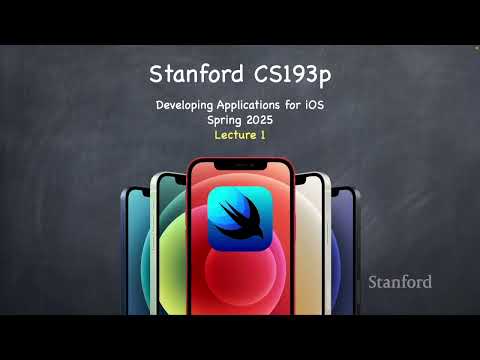
This is the opening lecture of Stanford University's CS193p iOS Application Development course for Spring 2025, taught by Paul Hegarty, who has led this class for 14 to 15 years—nearly since the original iPhone launch. The course teaches cross-platform development using SwiftUI, with code that works seamlessly across iPhone, iPad, macOS, Apple Watch, Apple TV, and visionOS with minimal adjustments.
The course follows a unique narrative teaching approach: instead of building dozens of small, disconnected example apps, students will collaborate on one large, feature-complete app over the first six to seven weeks. This method mirrors real-world software development, showing how codebases grow and evolve over time. The final three weeks are dedicated to a self-directed final project where students apply their skills to build any app they choose.
The lecture begins with a full course overview, followed by a guided tour of the Xcode development environment, and concludes with a deep dive into the fundamental building blocks of SwiftUI: views and view composition.
Two. Key Learning Takeaways
SwiftUI is a reactive, protocol-oriented UI framework, not an object-oriented one. It uses functional programming principles instead of inheritance. All SwiftUI views are lightweight structs that conform to the View protocol, rather than heavyweight classes. The only requirement to be a View is implementing the body computed property, which returns some other View. Xcode's live preview canvas compiles and runs code in real time, enabling instant visual feedback as you write UI code. @ViewBuilder is a special Swift feature that automatically combines multiple views into a single tuple view, eliminating boilerplate code. Swift is a strongly typed language where every variable must have a concrete type and a valid value at all times. Layout in SwiftUI is built with container views like VStack, HStack, and ZStack that arrange their child views. The course prioritizes hands-on coding over exams: assessment is based entirely on five sequential programming assignments and a final project.
Three. Course Gold Quotes
"SwiftUI is not object-oriented. It's protocol-oriented and functional programming. That's going to be completely new for most of you." "The best way to learn a system like this is to actually write the code. I'm not going to give you take-home tests about concepts. I'm just going to tell you to go write the code." "Xcode's preview canvas is even more amazing than the simulator. It compiles and runs your code in real time as you type. That's how you're going to do 95% of your development." "Think of SwiftUI views like Legos. Bricks, helicopters, bags of bricks, and instruction manuals—they're all Legos. Everything is a View." "We use leading and trailing instead of left and right. That's for localization. We want our apps to work the same way in right-to-left languages like Arabic and Hebrew." "The @ViewBuilder is magic. It takes a list of views and bags them up into a single view for you. You never have to type TupleView yourself." "If you ignore Canvas and Ed Discussion, you will not learn in this class. I answer Ed Discussion questions really fast—use it."
Four. Layered Learning Notes
Module 1: Course Philosophy and Structure
The course is designed to teach real-world iOS development skills through immersive, hands-on practice. Unlike traditional computer science classes that focus on theory, CS193p is almost entirely project-based. The narrative approach of building one large app over six weeks teaches students how to manage growing codebases, refactor code, and add features incrementally—skills that are essential for professional software development.
Prerequisites include strong general coding experience, preferably with multiple structured programming languages. Students coming directly from an introductory programming class will find the workload extremely heavy, as the course requires writing large amounts of production-quality Swift code.
Module 2: Xcode Development Environment Tour
Xcode is the official integrated development environment for all Apple platforms. The lecture provides a spiral tour of Xcode's interface, starting from the edges and moving to the central code editor:-
Navigator (left pane): Manages project files, Git repositories, search, breakpoints, and build logs. Most developers keep this closed most of the time to save screen space.
-
Toolbar: Contains the run/stop buttons, destination selector (for choosing simulators or devices), and the library button.
-
Library: A critical resource that contains all built-in views, view modifiers, code snippets, colors, images, and SF Symbols.
-
Inspector (right pane): Allows visual editing of UI elements, automatically generating corresponding SwiftUI code. This is primarily used by designers and localizers, not developers in this course.
-
Preview Canvas: The most important feature for SwiftUI development. It shows a live, interactive preview of your UI that updates instantly as you edit your code. You can test different device sizes, dark mode, and font sizes directly in the preview.
-
Console/Debugger: Located at the bottom, it shows runtime output and allows inspection of variables during debugging.
Module 3: Swift Language Fundamentals
Swift is a modern, multi-paradigm programming language that combines the best features of functional, object-oriented, and protocol-oriented languages. Key concepts introduced in this lecture include:-
Structs: The primary data structure in Swift. Unlike classes, structs are value types, have no inheritance, and are extremely lightweight. Almost everything in SwiftUI is a struct.
-
Variables: Declared with the
varkeyword. Swift is strongly typed, so every variable has an explicit or inferred type. All variables must have a valid value at all times. -
Computed Properties: Variables whose value is calculated on demand every time they are accessed. The
bodyproperty of all Views is a computed property. -
Functions: First-class citizens in Swift. They can be passed as arguments to other functions, returned from functions, and stored in variables.
-
Optionals: A special type that represents the absence of a value. This eliminates null pointer exceptions common in other languages.
Module 4: Core SwiftUI View Protocol
The entire SwiftUI framework is built around the View protocol. Any struct that conforms to View can be used as a UI element. The only requirement for conformance is implementing the body computed property, which returns some View.
The some View return type is a special Swift feature called an opaque return type. It tells the compiler that the function returns a specific concrete type that conforms to View, but hides that type from the caller. This allows the compiler to optimize performance while keeping code clean and readable.
Module 5: View Composition and @ViewBuilder
SwiftUI uses a declarative syntax for building UIs. You describe what your UI should look like, and the framework handles the rest. Views are composed by nesting them inside container views:-
VStack: Arranges child views vertically -
HStack: Arranges child views horizontally -
ZStack: Arranges child views on top of each other
The @ViewBuilder attribute is what makes this declarative syntax possible. When applied to a function or computed property, it automatically interprets a list of views as a single combined view. This eliminates the need for manual array creation and makes UI code read almost like natural language.
These are structured study notes and in-depth interpretations I compiled by watching the public lecture. I hope this knowledge framework helps you master the subject thoroughly. Wishing you academic progress and fruitful learning.
May you build beautiful, intuitive apps with confidence as you explore the power of SwiftUI. Enjoy every step of your development journey, and may your code run smoothly and your previews never crash. Good luck with your assignments and final project!